A championship ring is not just jewelry. It is a condensed autobiography — a story of a season compressed into precious metal and stone, worn on a finger where it catches light and draws questions and conversation. The tradition of awarding rings to championship-winning teams has produced some of the most elaborate and symbolically rich pieces of sports jewelry ever created, and their evolution from modest bands to extravagant statement pieces mirrors the growth of professional football itself.
The craftsmanship behind these rings involves techniques borrowed from fine jewelry, industrial manufacturing, and artistic sculpture. Understanding how championship rings are designed and produced reveals a fascinating intersection of sports tradition, skilled craftsmanship, and symbolic storytelling that goes far deeper than the sparkle visible to the casual observer.
Origins of the Championship Ring Tradition
The practice of awarding rings to champions did not begin with the Super Bowl. Championship rings in professional football predate the modern era, with teams receiving jewelry after winning NFL championships as far back as the 1930s. These early rings were simple affairs — gold bands with modest engraving, sometimes featuring a single stone or a team initial rendered in enamel.
The Green Bay Packers’ ring from their 1936 NFL Championship is among the earliest documented examples. It was a modest yellow gold band with the team name engraved around the circumference, reflecting an era when professional football players earned modest salaries and championship rewards were proportionally understated. The ring communicated achievement without ostentation — a design philosophy that would gradually give way to far more elaborate expressions.
Through the 1940s and 1950s, championship rings grew slowly in complexity. Diamonds appeared, initially as single stones set into the ring face. Engraving became more detailed, incorporating team logos alongside player names and championship years. The metals remained predominantly yellow gold, though the weight and width of bands increased modestly over the decades.
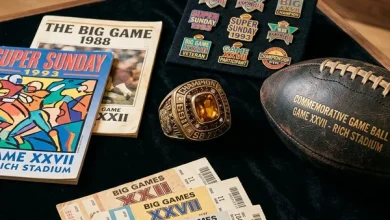
The establishment of the Super Bowl in 1967 created a new focal point for championship ring design. The first Super Bowl ring, awarded to the Green Bay Packers after their victory in Super Bowl I, featured a single diamond set in a gold mount with “World Champions” engraved alongside the team name. By the standards of what would come later, it was restrained — but it established the Super Bowl ring as a distinct category of championship jewelry with its own evolving design language.
The Design Process
Creating a championship ring begins long before any metal is cast or stone is set. The design process typically starts within days of the championship game, when representatives from jewelry manufacturers meet with team ownership and, increasingly, with players and coaches to discuss the ring’s concept.
Major jewelry firms compete for the contract to produce each year’s championship rings. The winning firm works closely with the team to develop a design that captures the character of the season, the identity of the franchise, and the personal preferences of the players and staff who will wear the finished pieces. This collaborative process can involve dozens of design iterations, with sketches and three-dimensional renderings reviewed and revised over several weeks.
Teams have varying approaches to design input. Some organizations give players significant influence over the ring’s appearance, soliciting opinions on stone arrangements, metal choices, and symbolic elements. Others delegate design authority primarily to ownership and front-office personnel. The most successful designs typically result from a balanced process that incorporates institutional identity with personal touches meaningful to the people who earned the championship on the field.
Computer-aided design (CAD) technology has transformed the design phase. Modern ring designs are developed digitally, allowing designers to visualize the finished piece from every angle, adjust proportions precisely, and simulate how light will interact with stone placements before any physical prototype is created. Three-dimensional printing technology enables rapid production of resin or wax prototypes that stakeholders can hold and evaluate in person before committing to the final design.
Materials and Construction
Championship ring construction involves multiple material categories, each contributing different properties to the finished piece. Understanding these materials illuminates why championship rings look and feel the way they do.
Precious Metals
Gold remains the dominant base metal for championship rings, available in several alloy compositions. Yellow gold — the traditional choice — provides the warm, rich appearance most commonly associated with championship jewelry. White gold offers a cooler, more contemporary aesthetic that has gained popularity in recent decades. Rose gold, with its distinctive pinkish hue, appears occasionally as an accent material.
Gold purity is measured in karats, with 24-karat representing pure gold. Championship rings typically use 10-karat or 14-karat gold alloys. Pure gold is too soft for a ring that will be worn regularly, so it is alloyed with harder metals — copper, silver, zinc, or palladium — to achieve the durability required for daily wear. The specific alloy composition affects both the color and hardness of the finished ring.
Platinum has appeared in some championship rings, particularly as a setting material for premium stone placements. Its natural white color does not require rhodium plating (unlike white gold), and its density gives rings a substantial, weighty feel that some wearers prefer. However, platinum’s higher cost limits its use primarily to accent applications rather than full ring construction.
Gemstones
Diamonds dominate championship ring stone settings. The number of diamonds in championship rings has escalated dramatically over the decades — from the single stone of early rings to hundreds of individually set stones in modern designs. Diamond quality in championship rings typically falls in the mid-to-upper range of commercial grading scales, balancing visual impact with the practical constraints of setting large numbers of stones in a piece of jewelry that will be worn rather than displayed behind glass.
Colored gemstones serve specific symbolic purposes. Rubies, sapphires, and emeralds may represent team colors, while synthetic stones or colored diamonds can achieve precise color matching that natural stones cannot. Some rings incorporate birthstones, championship game scores rendered in colored stones, or other personalized elements that make each ring unique to its recipient.
Custom-cut stones — diamonds or other gems shaped to fit specific design elements — represent the highest level of stone-setting craftsmanship in championship rings. Rather than selecting stones from standard shapes (round, princess, emerald), custom cutting allows stones to follow the contours of logo elements, letter shapes, or decorative patterns unique to a particular ring design.
Enamel and Surface Treatments
Enamel work allows designers to incorporate precise team colors into ring designs. Hard enamel — a glass-like material fused to metal at high temperatures — provides durable, scratch-resistant color that maintains its vibrancy over decades of wear. Soft enamel, applied at lower temperatures, allows for finer detail but is less resistant to abrasion.
Laser engraving has expanded the level of detail possible on ring surfaces. Modern championship rings may feature microscopic text, fine-line portraits, or intricate pattern work achieved through laser technology that would be impossible with traditional hand engraving tools. This capability allows designers to pack an extraordinary density of information and symbolism into the limited surface area of a ring.
Symbolic Elements in Ring Design
Championship rings communicate through a carefully considered language of symbols. Every design element — from the arrangement of stones to the text on the inner band — carries meaning that connects the ring to the specific championship it commemorates.
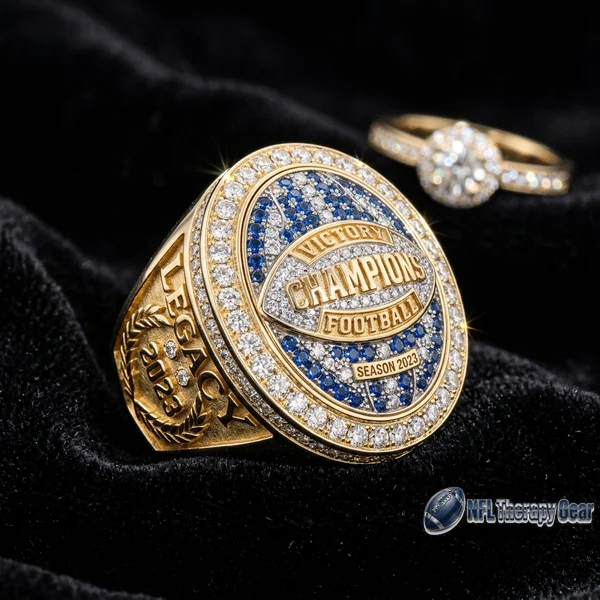
The ring face, or “top,” typically features the team logo rendered in precious materials. This central element establishes franchise identity and is usually the most visually prominent feature of the ring. Surrounding the logo, designers may incorporate the championship game number, the season year, or phrases commemorating the achievement.
Ring shoulders — the sides of the band — carry additional narrative content. One shoulder commonly displays the player’s name and jersey number, while the opposite shoulder might show the team’s season record, a stadium image, or a symbolic representation of the championship game. Some designs extend storytelling across both shoulders, creating a sequential narrative that unfolds as the ring is rotated.
Interior engravings occupy the band’s inner surface, visible only when the ring is removed. These private inscriptions often include motivational phrases chosen by the team, coaching staff mantras, or personal messages that carry meaning specific to the season’s journey. The contrast between the ring’s public spectacle and its private inscriptions reflects the dual nature of championship achievement — a public performance built on private commitment.
Hidden details have become a signature element of modern championship ring design. Designers embed small symbols, initials, or numbers in unexpected locations — beneath stone settings, inside hinged panels, or within micro-engraved patterns. These Easter eggs reward close inspection and give ring owners discoveries to share with others who examine the piece carefully.
Evolution Across Decades
Tracking championship ring design decade by decade reveals a clear trajectory toward increasing size, complexity, and material richness. The trajectory is not perfectly linear — individual teams and designers occasionally bucked prevailing trends — but the overall direction is unmistakable.
Rings from the 1970s typically featured a single prominent stone (often a diamond) surrounded by smaller accent stones, set in a gold band with engraved team information. Total diamond counts rarely exceeded twenty or thirty stones. The rings were substantial by jewelry standards but modest compared to what would follow.
The 1980s and 1990s saw significant escalation. Diamond counts increased into the dozens and then hundreds. Ring profiles grew taller, creating more surface area for stone settings and design elements. Multiple metal colors appeared in single designs, with white gold or platinum accents contrasting against yellow gold bases. The rings of this era began to resemble the elaborate statement pieces that define the modern championship ring aesthetic.
Twenty-first century championship rings pushed boundaries further. Total diamond counts reached into the hundreds, with some rings featuring over five hundred individually set stones. Ring weights increased correspondingly — modern championship rings can weigh several ounces, a substantial mass of precious metal and gemstone that makes them impractical as everyday jewelry for many recipients.
Mechanical elements have appeared in recent ring designs. Hinged panels that open to reveal hidden compartments, removable sections that transform the ring into a pendant, and illuminated elements powered by tiny batteries represent engineering innovations that blur the line between jewelry and mechanical art.
Production and Distribution
The production process for championship rings involves both high-technology manufacturing and traditional hand craftsmanship. After the design is finalized and approved, production begins with creating master molds from which individual rings will be cast.
Lost-wax casting — a technique used in jewelry making for thousands of years — remains the primary method for forming ring bodies. A wax model of the ring is created (today, typically from a 3D printer), encased in plaster-like investment material, and heated until the wax melts away, leaving a hollow mold. Molten gold is then poured into the mold, filling the space left by the wax and taking on its precise shape.
Stone setting follows casting and represents the most labor-intensive phase of production. Master stone setters individually place and secure each diamond and gemstone using techniques that have been refined over centuries. Despite advances in manufacturing technology, stone setting remains fundamentally a hand-craft skill that requires years of training and exceptional manual dexterity.
Each ring is custom-sized for its recipient, requiring individual casting or sizing adjustments. The number of rings produced for each championship varies by organization — typically between one hundred fifty and two hundred pieces, distributed to players, coaches, training staff, front-office personnel, and selected associates of the franchise. This controlled distribution contributes to the exclusivity that makes championship rings significant beyond their material composition.
The timeline from championship game to ring delivery typically spans three to five months. Design consultation, approval cycles, material procurement, casting, stone setting, finishing, and quality inspection each require dedicated time. Teams generally host formal ring ceremonies where the finished pieces are presented to recipients, creating memorable events that add ceremonial significance to the physical distribution of the jewelry.
Care, Maintenance, and Preservation
Championship rings, despite their precious construction, require ongoing care to maintain their appearance and structural integrity over years and decades of ownership. Gold alloys can scratch, enamel can chip, and diamond settings can loosen through regular wear — maintenance practices help prevent these issues and address them when they occur.
Professional cleaning by a qualified jeweler should be performed periodically to remove accumulated oils, lotions, and environmental residue that dulls the ring’s appearance. Ultrasonic cleaning — which uses high-frequency sound waves to dislodge particles from intricate settings — is effective for diamond-set rings but should be avoided for rings containing enamel or fragile colored stones that may be damaged by vibration.
Setting inspections are equally important. A jeweler can check each stone setting for security, identifying prongs that have worn thin or settings that have loosened before a stone is lost. For rings containing hundreds of small diamonds, systematic inspection under magnification ensures that all stones remain properly seated.
Storage away from other jewelry prevents surface scratching. Championship rings should be stored individually in soft-lined compartments or pouches, not tossed into a drawer with other metal objects. When displayed rather than worn, rings benefit from the same climate and UV considerations that apply to other memorabilia — controlled temperature, moderate humidity, and protection from direct sunlight that can fade enamel colors over extended periods.
Insurance considerations for championship rings warrant careful attention. Given the combination of precious materials, historical significance, and personal provenance, these pieces often require specialized insurance coverage that accounts for both their material and cultural dimensions. Owners should maintain detailed photographic documentation from multiple angles, including close-up images of engravings, stone settings, and any personalized details. This documentation serves dual purposes: supporting insurance claims if needed and preserving a visual record that captures the ring’s condition at specific points in time.
Professional appraisals conducted by jewelers experienced with sports memorabilia provide the foundation for adequate insurance coverage. Standard jewelry appraisals assess material composition and gemstone quality, but championship rings carry additional significance rooted in their athletic provenance. Appraisers familiar with the sports memorabilia market can better account for this intangible dimension, which can represent a substantial portion of a ring’s overall significance within the broader collecting community.
Championship rings occupy a singular position in sports memorabilia because they are simultaneously personal possessions and cultural artifacts. They are worn on fingers but studied in museums. They belong to individuals but represent collective achievement. The craftsmanship that goes into each ring reflects this dual nature — every design decision balances personal expression with institutional identity, private meaning with public spectacle, artistic vision with the physical demands of an object built to last a lifetime.
References:
- Pro Football Hall of Fame — Championship Ring Collection and History
- NFL.com — Super Bowl Championship Heritage
- Gemological Institute of America (GIA) — Diamond Grading and Gemstone Standards
- Smithsonian National Museum of American History — Sports Jewelry and Cultural Artifacts
- JCK (Jewelers’ Circular Keystone) — Jewelry Industry Craftsmanship and Manufacturing