A felt pennant hanging on a bedroom wall is one of the defining visual memories of American sports fandom. For generations of children and adults, these triangular fabric banners served as the most accessible, most visible declaration of team allegiance — a splash of team color thumbtacked above a desk, pinned to a dorm room wall, or displayed in a basement recreation room where Sunday afternoons were spent watching football.
Pennants occupy a peculiar position in the memorabilia hierarchy. They were never expensive items. They were mass-produced souvenirs sold at stadium concession stands, sporting goods stores, and gas stations. Yet precisely because they were ubiquitous, handled by millions of fans, and often discarded after a few seasons of display, vintage pennants in good condition have become genuinely scarce artifacts that document the visual identity of NFL franchises across decades of change.
Origins of the Football Pennant
The felt pennant tradition in American sports predates professional football. College football, baseball, and other sports used triangular felt banners as souvenir items beginning in the early twentieth century. When professional football began developing its commercial infrastructure in the 1930s and 1940s, pennants were among the first merchandise items produced for fan consumption.
Early professional football pennants were simple items. A triangle of wool felt, typically between twenty-four and thirty inches long, was screen-printed or embroidered with a team name and perhaps a simple graphic element. Colors corresponded to team colors, though the limited dye options available for felt production meant that color accuracy varied — a team’s official shade of blue might appear as navy, royal, or powder blue depending on the felt manufacturer’s available inventory.
The manufacturing process for these early pennants was straightforward. Felt — a non-woven fabric made by compressing and matting fibers, typically wool or wool blends — was cut into triangular shapes using templates. Text and graphics were applied through screen printing using textile inks formulated for adhesion to felt surfaces. Some premium pennants featured embroidered text or appliqued felt letters and shapes, adding dimensional texture that distinguished them from their screen-printed counterparts.
Distribution channels for early pennants were primarily local. Fans purchased them at stadium souvenir stands on game days, at nearby shops and newsstands, and through mail-order advertisements in football programs. The pennant was an impulse purchase — inexpensive enough to buy without deliberation, portable enough to carry through the stadium, and durable enough to survive the trip home and find a spot on a wall or bulletin board.
Design Evolution by Decade
The 1940s and 1950s
Pennants from the 1940s and 1950s reflect the modest graphic ambitions of early professional football merchandising. Team names were rendered in block lettering, sometimes with a player illustration or team mascot drawn in a cartoonish style typical of the era. Color palettes were limited — most pennants used two or three colors, with the felt base providing one color and screen-printed elements adding one or two more.
The graphic illustrations on pennants from this period have a distinctive charm that reflects contemporary commercial art conventions. Football players were depicted in exaggerated action poses — throwing spirals, stiff-arming tacklers, or charging forward with the ball — rendered in a simplified, illustrative style that prioritized energy and readability over realistic anatomy. These illustrations often bore little resemblance to actual players, serving instead as generic representations of football action associated with the team name.
The 1960s and 1970s
The merger era brought significant changes to pennant design. As the NFL and AFL combined their rosters and the league’s national television presence grew, pennants became more sophisticated in their graphic presentation. Team logos — many of which were being formalized and standardized during this period — appeared on pennants with increasing frequency, replacing the informal illustrations of earlier decades.
Pennant sizes expanded during this period, with some manufacturers producing extra-long formats that could span three feet or more. Felt quality varied more widely as manufacturers balanced production costs against retail price points. Premium pennants used thicker, denser felt with more saturated colors, while economy versions used thinner material with less vibrant dyeing.
The introduction of synthetic felt — blends incorporating polyester, rayon, or acrylic fibers alongside or replacing traditional wool — changed the texture and appearance of pennants during the late 1960s and into the 1970s. Synthetic felts offered cost advantages and color consistency but produced a different tactile quality that experienced collectors can distinguish from all-wool examples by feel alone.
The 1980s to Present
Modern pennants have continued evolving in materials and design complexity while maintaining the basic triangular format that defines the category. Full-color printing processes replaced the limited palette of traditional screen printing, allowing pennants to reproduce photographic images, complex logo treatments, and detailed graphic elements that earlier manufacturing methods could not achieve.
Pennant materials expanded beyond felt to include synthetic fabrics, mesh materials, and even rigid substrates designed more for wall display than for the traditional hand-waving use that characterized early pennant culture. These newer materials offer superior durability and print quality but lack the textural warmth and historical association of traditional felt.
Commemorative pennants — produced for specific events such as Super Bowls, division championships, or stadium milestones — became an important sub-category. These limited-production pieces carry specific dates, scores, and event references that tie them to particular moments in football history, adding narrative specificity beyond the general team affiliation of standard season pennants.
Franchise Relocations and Name Changes
Pennants gain particular historical interest when they represent team identities that no longer exist. Franchises that have relocated, changed names, or folded leave behind pennants bearing names and logos that have disappeared from active use. These orphaned identities — the Baltimore Colts, the Houston Oilers, the St. Louis Cardinals, the Los Angeles Raiders — exist on vintage pennants as tangible artifacts of football geography that has been rewritten.
For fans who remember these identities from childhood or family tradition, pennants bearing defunct team names carry emotional weight that extends beyond their material value. A Houston Oilers pennant hanging in a Texas living room represents not just a football team but a specific chapter in a city’s cultural history — the years when Columbia blue and oil derrick logos meant Sunday afternoons in the Astrodome.
The design variations within a single franchise’s pennant history can be extensive. Teams that have undergone multiple logo changes, color modifications, or name adjustments may have produced dozens of distinct pennant designs over the decades. Assembling a comprehensive pennant collection for a single franchise creates a visual timeline of that team’s evolving identity, from earliest designs through every subsequent iteration to the present.
Condition Factors for Vintage Pennants
Evaluating the condition of vintage felt pennants involves assessing several material-specific characteristics that differ from the condition factors relevant to paper, metal, or leather memorabilia. Understanding these factors helps collectors identify well-preserved examples and recognize the types of damage most commonly encountered in vintage pennants.
Felt degradation is the primary condition concern. Wool felt is susceptible to moth damage — small holes eaten through the fabric by larvae that feed on natural fibers. Moth damage is irreversible and can range from barely visible pinpoint holes to extensive sections of missing fabric. Examination under strong light reveals moth damage that might be invisible in casual viewing, as the holes become apparent when light passes through the thinned fabric.
Color fading from UV exposure affects felt pennants that have been displayed in sunlit locations. The fading pattern typically follows the exposure pattern — pennants displayed vertically may show more fading at the top than the bottom, while those displayed near windows show more fading on the light-facing side. Severe fading can reduce vibrant team colors to washed-out pastels that bear little resemblance to the original appearance.
Print condition on screen-printed pennants depends on the ink formulation, the printing method, and the decades of environmental exposure the pennant has experienced. Cracking, flaking, and peeling of printed elements are common in vintage examples, particularly those printed with thick, inflexible ink layers that lose adhesion as the underlying felt ages and shifts texture.
Structural issues include tears along the fold line at the narrow end of the triangle (where the pennant was attached to a stick or dowel), edge fraying where the cut felt has deteriorated, and holes from tacks, pins, or staples used to mount the pennant for display. These mounting damage points are so common in vintage pennants that their presence is expected rather than exceptional.
Preservation and Display Techniques
Preserving vintage felt pennants requires storage and display approaches tailored to the specific vulnerabilities of textile collectibles. The primary threats — moths, UV exposure, moisture, and physical stress — can be managed through informed practices that extend the lifespan of these fabric artifacts considerably.
Moth prevention starts with clean storage. Moths are attracted to soiled textiles, and pennants that retain dust, body oils, or food residue from decades of display or handling are more vulnerable than clean examples. Gentle surface cleaning with a soft brush or low-suction vacuum removes surface contaminants without subjecting the felt to water or chemical cleaning agents that could affect dye stability or print adhesion.
Acid-free tissue interleaving prevents color transfer between stacked pennants and provides a buffer against chemical interaction between dyes. Pennants stored in contact with each other can experience dye migration — color bleeding from one pennant onto an adjacent one — particularly in humid conditions. Tissue barriers eliminate this risk.
Display mounting should distribute the pennant’s weight evenly rather than concentrating stress at pin points. Museum-style mounting involves sewing the pennant to a fabric-covered backing board using small, widely spaced stitches that support the felt without creating stress concentrations. This approach eliminates the holes and tears associated with pin or tack mounting while allowing the pennant to hang flat against its display surface.
UV-filtering glass or acrylic in framed displays protects against the light-induced fading that is the most common form of damage to displayed pennants. The cost premium for UV-filtering glazing is modest relative to the protection it provides, making it a worthwhile consideration for any pennant displayed in a room with natural light exposure.
Temperature and humidity stability matters for felt preservation just as it does for other textile collectibles. Wool felt is hygroscopic — it absorbs and releases moisture in response to environmental changes — and repeated cycles of absorption and release weaken the fiber structure over time. Stable indoor environments with moderate humidity provide the most supportive conditions for long-term preservation of felt pennants and other textile memorabilia items.
The Pennant Stick Tradition
Original pennants were sold with wooden dowels or sticks inserted through a hem along the pennant’s narrow edge, creating a handle that allowed fans to wave the pennant during games. This game-day use — waving, cheering, pumping the pennant in the air — subjected pennants to physical stresses that contributed to the wear and damage visible in many surviving examples. Sticks were often lost or discarded after the game, and pennants that retain their original sticks are less common than those without.
The pennant stick itself evolved over the decades. Early sticks were plain wooden dowels, sometimes painted in team colors. Later versions incorporated printed team names, plastic ferrules at the pointed end, and even small flags or streamers attached to the tip. Some manufacturers offered premium sticks with turned handles or rubber grips, distinguishing their products from competitors’ simpler offerings.
For display purposes, the presence or absence of the original stick affects presentation options. Pennants with sticks can be displayed upright in stands or mounted horizontally with the stick visible as part of the presentation. Pennants without sticks are more commonly displayed flat, either pinned to walls or mounted in frames. Some collectors who acquire pennants without original sticks source period-appropriate replacement dowels to create historically accurate display presentations.
Super Bowl and Championship Pennants
Super Bowl pennants represent a significant sub-category within NFL pennant collecting. Produced for each championship game since Super Bowl I, these commemorative pennants document the participating teams, the game date and location, and often include distinctive graphic elements specific to each Super Bowl’s visual branding.
Dual-team Super Bowl pennants — featuring both the AFC and NFC champions on a single pennant — provide a compact visual summary of each championship matchup. These pennants typically display both team logos, the Super Bowl number and logo, and the game venue. The design challenge of incorporating two team identities and championship branding into a single triangular format has produced creative graphic solutions that vary considerably across different Super Bowl years.
Winner-specific pennants, produced after the game’s outcome is determined, carry the additional information of the final score and championship declaration. These post-game pennants were often sold in the championship city and at the winning team’s home stadium in the days and weeks following the Super Bowl, making them souvenirs tied to specific celebration moments.
Conference championship pennants, division title pennants, and regular-season commemorative pennants (celebrating stadium milestones, franchise anniversaries, or record-breaking achievements) expand the collecting landscape beyond the Super Bowl. Each of these sub-categories carries its own production characteristics, distribution history, and relative scarcity that inform collecting decisions.
Building a Pennant Display
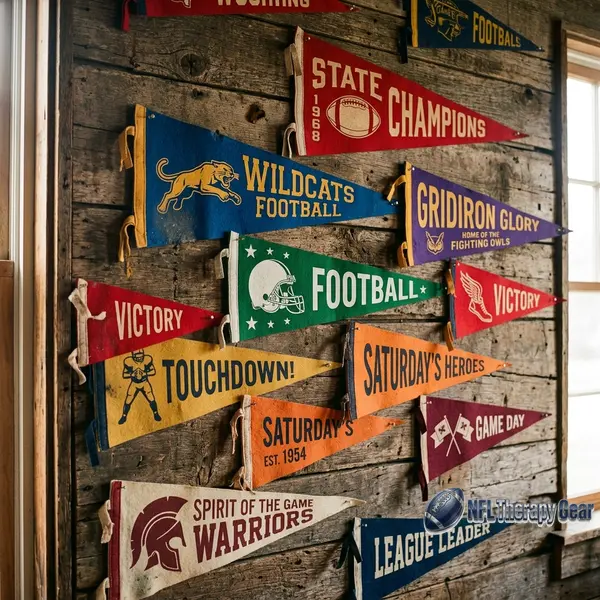
The visual appeal of pennant collections stems partly from the triangular format’s natural compatibility with wall display arrangements. Multiple pennants mounted together create geometric patterns that transform a wall into a colorful celebration of team history and football heritage. Display arrangements range from simple linear rows to complex multi-level compositions that fill entire walls with team-colored felt triangles.
Chronological arrangements — ordering pennants by year of production — create visual timelines that trace a franchise’s evolving graphic identity. Viewers can follow the progression from simple hand-lettered designs through increasingly sophisticated logo treatments, observing how changing tastes in graphic design and improvements in printing technology shaped the visual presentation of team identity across decades.
Multi-team displays, arranging pennants from all teams in a division, conference, or the entire league, create comprehensive visual surveys of professional football’s geographic and competitive landscape. These displays often reveal interesting patterns — how teams in the same division used similar or contrasting color schemes, how logo design philosophies differed between established franchises and expansion teams, and how regional aesthetic preferences influenced visual identity choices across different parts of the country.
Shadow box frames designed for pennants allow flat display behind glass while maintaining the three-dimensional texture of the felt surface. These frames typically provide sufficient depth to accommodate the pennant’s thickness without pressing the felt against the glazing surface, which can cause permanent compression marks in the fabric pile. Quality shadow box presentations transform casual souvenirs into museum-quality displays that elevate the perceived significance of even modest pennants.
Vintage NFL pennants endure as collectibles because they combine accessibility, visual impact, and historical resonance in a format that has remained essentially unchanged for nearly a century. The triangular felt banner — simple in concept, rich in association — continues to serve as one of professional football’s most recognizable and emotionally evocative souvenir forms. Whether waved at a stadium, tacked to a bedroom wall, or carefully preserved in an archival frame, the pennant remains a fundamental expression of the connection between fan and team.
References:
- Pro Football Hall of Fame — Pennant and Textile Memorabilia Collection
- NFL.com — Team History and Franchise Chronology
- Smithsonian National Museum of American History — Textile Conservation Guidelines
- American Institute for Conservation — Textile Preservation Standards
- Library of Congress — Preservation and Care of Historical Textiles