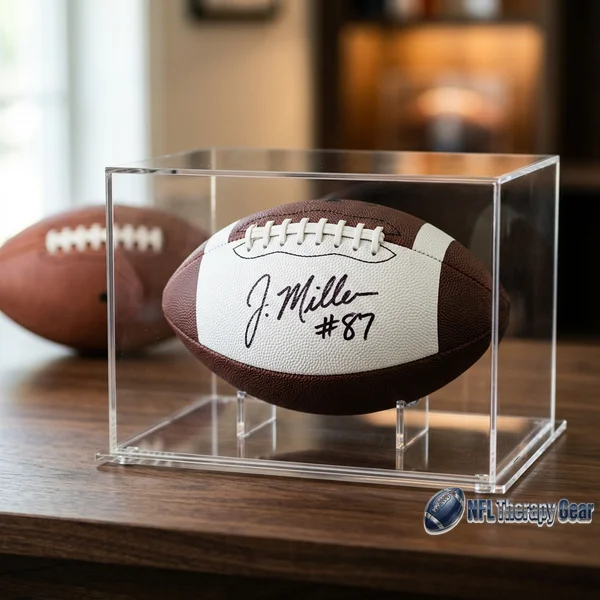
A signed football is an oddly personal object. Someone — a professional athlete whose physical abilities millions have watched on television — took a pen to leather and left a mark. That mark transforms a mass-produced piece of sporting equipment into something singular. The football industry produces hundreds of thousands of balls each year, but only a fraction carry the handwriting of the people who threw, caught, and ran with them in professional competition.
For fans and collectors who own or are considering acquiring signed footballs, understanding the mechanics of authentication and the principles of proper display matters considerably. A signature without verification is just ink. A verified signature without proper care is a deteriorating artifact. This article covers both aspects — how the memorabilia community establishes that a signature is genuine, and how collectors protect their authenticated items for the long term.
Understanding Autograph Authentication
Authentication exists because forgery exists. The market for signed sports memorabilia is large enough to attract individuals willing to produce counterfeit signatures, and the difference between a genuine signature and a skilled forgery can be difficult for untrained eyes to detect. Third-party authentication services emerged to address this problem, providing expert evaluation and standardized verification processes.
The authentication process generally involves several layers of examination. The first is visual comparison — placing the signature in question alongside known genuine examples from the same individual. Authenticators maintain extensive databases of verified signatures, compiled over years of examination. They study not just the final appearance of the signature but the specific stroke patterns, pressure variations, and habitual characteristics that define each signer’s handwriting.
Beyond visual comparison, authenticators consider contextual factors. When and where was the item reportedly signed? Does the pen type match what the player typically used during that period? Does the surface of the football show appropriate ink absorption for the era? A signature purportedly obtained in 1975 should reflect the signing habits and pen technology of that decade. Anachronistic elements — a modern felt-tip marker on a ball claimed to have been signed in the 1960s, for instance — raise red flags that warrant closer scrutiny.
Several established organizations operate in the sports autograph authentication space. These firms employ specialists whose backgrounds include forensic document examination, handwriting analysis, and decades of experience in the memorabilia industry. When an item passes authentication, it typically receives a certificate of authenticity (COA), a unique identification number, and sometimes a tamper-evident holographic sticker that links the physical item to its authentication record.
The Layers of Verification
Not all authentication carries the same weight, and collectors benefit from understanding the hierarchy. The strongest form of authentication is a witnessed signature — one signed in the presence of an authorized representative from a recognized authentication firm. The representative observes the signing, immediately certifies the item, and applies identification markers. This process eliminates questions about the signature’s origin because the chain of custody begins at the moment of signing.
The next tier involves submissions for expert review. A collector submits an item to an authentication firm, where specialists examine it against their database of known genuine signatures. This process is necessarily more subjective than witnessed authentication because the experts must evaluate the signature without having seen it applied. Disagreements between authentication firms on the same item, while not common, do occur and reflect the inherent judgment involved in evaluating handwriting.
Below third-party authentication sits the category of provenance-based authentication. This relies on documentation showing the circumstances of the signing — a letter from the player, a photograph of the signing event, a receipt from a charity auction — rather than expert examination of the handwriting itself. Provenance evidence can support authenticity but is generally considered insufficient on its own, as documents can be fabricated more easily than signatures can be convincingly forged.
The least reliable form of authentication is the seller’s verbal assurance. Claims like “I watched him sign this myself” or “I got this at a private event” carry essentially no verification weight in the formal authentication framework. This is not necessarily because such claims are false — many are perfectly truthful — but because they are unverifiable by third parties and provide no protection against good-faith mistakes or deliberate deception.
What Authenticators Look For
Professional authenticators evaluate autographs across multiple dimensions. Understanding these evaluation criteria helps collectors appreciate what makes a signature verifiable and why some items fail authentication even when the owner genuinely believes they are authentic.
Pen pressure is one key factor. Every person applies a characteristic amount of force when writing, and this pressure creates measurable effects on the writing surface. Heavy-handed signers leave deeper impressions in leather and broader ink lines. Light signers produce thinner, more delicate strokes. Forgers who study the visual appearance of a signature often fail to replicate the original signer’s pressure habits because they are focused on letter shapes rather than the physical mechanics of writing.
Flow and hesitation marks reveal another layer of information. A genuine autograph is typically executed with fluency — the signer has written their name thousands of times and the movement is largely automatic. Forged signatures often show hesitation marks: tiny pauses, tremors, or directional corrections where the forger stopped to assess their progress or adjust their approach. These interruptions in flow are difficult to eliminate entirely, even for skilled forgers, and trained authenticators can detect them through magnification.
Letter formation habits — the specific way an individual shapes each character — provide perhaps the most detailed comparison data. People develop idiosyncratic habits in their handwriting: the height ratio between capital and lowercase letters, the angle of ascending and descending strokes, the shape of loops, the connection or disconnection between letters. These habits persist even as signatures evolve over time, providing a consistent baseline against which questioned signatures can be evaluated.
Ink analysis, while less commonly performed on routine submissions, can provide definitive dating information. Different eras used different ink formulations, and chemical analysis can determine whether the ink on a football is consistent with the claimed signing date. This type of analysis is typically reserved for high-value items where the cost of testing is justified by the potential significance of the result.
The Football as a Signing Surface
Footballs present particular challenges and opportunities as autograph surfaces that distinguish them from other commonly signed items like photographs, jerseys, or flat cards. The leather panels of a football have a pebbled texture — the characteristic small bumps created during the manufacturing process — that affects how ink adheres to and spreads across the surface.
On a new football with a tight pebble grain, ink from a felt-tip marker tends to sit on the surface of the leather rather than being fully absorbed. This produces signatures with crisp edges and relatively uniform line width. On worn or conditioned leather, where the pebble grain has been softened through use or treatment, ink absorbs more readily, creating slightly softer signature edges and potentially wider line variation.
The curvature of a football adds another variable. Signing on a curved surface requires different hand mechanics than signing on a flat surface. Signers must adjust their grip, wrist angle, and stroke length to account for the ball’s shape. This means that a person’s signature on a football may look slightly different from their signature on a photograph or flat surface — a difference that experienced authenticators account for in their evaluations.
The specific panel on which a signature appears also matters. Most footballs are signed on the white lace panel or one of the larger leather panels. The white panel offers maximum contrast and visibility for dark ink. The leather panels provide more surface area for larger signatures or multi-line inscriptions. Some signers have preferred panels based on personal habit, and authenticators familiar with specific players may note when a signature appears on an unusual panel.
Pen selection affects longevity and legibility. Permanent markers designed for non-porous surfaces — such as paint pens or industrial markers — produce more durable signatures on leather than standard felt-tip markers. Ballpoint pens, while producing fine lines on paper, often skip or produce inconsistent lines on the pebbled surface of a football. Authenticators sometimes note pen type as part of their evaluation, as certain pen technologies were not available during certain periods.
Display Methods and Best Practices
Once a signed football has been authenticated, proper display becomes the primary concern for long-term preservation. The goal is to present the item attractively while protecting it from the environmental factors that cause signatures to fade, leather to deteriorate, and structural integrity to diminish.
Display cases designed specifically for footballs are the most popular presentation method. These cases typically feature a clear acrylic or glass enclosure mounted on a base, with an internal cradle or stand that holds the football in a stable position. The case protects against dust, accidental contact, and — if the material includes UV-filtering properties — harmful ultraviolet radiation.
UV exposure is the single greatest threat to autographed footballs on display. Ultraviolet radiation from both sunlight and fluorescent lighting causes ink to fade over time, gradually reducing the legibility of signatures. The rate of fading depends on the ink type, the intensity and duration of exposure, and the specific wavelengths present in the light source. Museum-quality display cases use UV-filtering acrylic that blocks the most damaging wavelengths while allowing visible light to pass through for viewing.
Temperature and humidity control affect leather preservation. Ideal conditions for football storage fall between sixty and seventy degrees Fahrenheit with relative humidity between forty and fifty-five percent. Excessive heat dries leather, causing cracking and brittleness. Excessive humidity promotes mold growth and can cause adhesive-backed authentication stickers to loosen. Significant temperature fluctuations — common in attics, garages, and non-climate-controlled storage spaces — create expansion and contraction cycles that stress both the leather and the stitching.
Orientation matters for long-term display. Footballs displayed in the same position for extended periods can develop flat spots where the weight compresses the leather against the display surface. Rotating the ball periodically — shifting which panel faces upward — distributes stress more evenly. Some display cases incorporate padded cradles that conform to the ball’s shape, reducing contact pressure at any single point.
Wall-Mounted and Shelf Display Options
Beyond traditional tabletop cases, several alternative display approaches serve collectors with space constraints or aesthetic preferences for different presentation styles. Wall-mounted displays position the football at eye level, making the signature immediately visible to visitors without requiring them to look down at a table or shelf.
Wall mounts typically grip the football at three or four contact points, suspending it away from the wall surface for an unobstructed view from all angles. Higher-quality mounts use padded or felt-covered contact points to prevent marking the leather surface. Mounting hardware should be rated for the weight of the football plus the mount itself, with proper wall anchoring to prevent the entire assembly from falling.
Shadow box displays combine the football with supporting materials — photographs, event programs, ticket stubs, or authentication documentation — creating a comprehensive presentation that tells a complete story. The challenge with shadow box displays is ensuring adequate depth for the football while maintaining proper spacing between elements. Professional framing services experienced with sports memorabilia can construct custom shadow boxes that accommodate the specific dimensions and display requirements of each piece.
Shelf display without a protective case is sometimes chosen by collectors who prefer a more casual presentation or who want the tactile option of picking up and examining the ball. While this approach allows for the most direct appreciation of the item, it exposes the football to dust accumulation, accidental handling, pet damage, and environmental fluctuations. Collectors who display without cases should commit to regular dusting with soft brushes and should position items away from windows, heating vents, and other sources of temperature or UV exposure.
Long-Term Care and Handling Protocols
Proper handling of signed footballs starts with clean, dry hands. Natural oils from skin can transfer to leather and interact with ink, potentially causing discoloration over time. Some collectors use cotton gloves when handling valuable signed items, though gloves can reduce grip and increase the risk of dropping the ball. A practical compromise is thorough hand-washing immediately before handling, followed by careful, two-handed support of the ball.
Leather conditioning presents a dilemma for signed footballs. Untreated leather gradually dries out, especially in low-humidity environments, and conditioning products can restore flexibility and prevent cracking. However, some conditioning agents contain solvents or oils that can interact with signature ink, causing smearing or migration. When conditioning is necessary, applying a small amount of product to an unsigned area first and observing the result over several days provides a conservative test before treating the entire surface.
Cleaning should be limited to gentle dusting and, if necessary, light wiping with a barely damp, lint-free cloth on unsigned areas. Avoid commercial leather cleaners, household cleaning products, and any solution containing alcohol or ammonia near signed surfaces. If a ball develops mold — typically indicating storage in excessively humid conditions — professional conservation treatment is preferable to home remediation attempts that could damage the signature.
For collectors storing signed footballs rather than displaying them, archival-quality storage involves acid-free tissue paper wrapped loosely around the ball, placed inside a clean cardboard box or fabric bag in a climate-controlled space. Avoid plastic bags or sealed containers, which can trap moisture and promote mold growth. Periodically checking stored items for signs of deterioration — cracking, mold, pest damage, or ink fading — allows early intervention when problems do occur.
Documentation of your collection is a preservation activity in its own right. Photographing each item from multiple angles, recording authentication numbers, noting the date and circumstances of acquisition, and maintaining copies of all certificates of authenticity creates a comprehensive record that protects against loss from fire, theft, or natural disaster. Digital backups of this documentation, stored separately from the physical collection, provide an additional safety layer that costs essentially nothing to maintain.
Signed footballs occupy a distinctive space in the memorabilia landscape because they combine athletic heritage with personal connection. The signature transforms a piece of equipment into a communication — a tangible point of contact between fan and player. Understanding how to verify and preserve that connection allows collectors to appreciate their items not just as objects but as artifacts of meaningful moments in sports history.
References:
- Pro Football Hall of Fame — Memorabilia Conservation and Collection Standards
- American Institute for Conservation — Guidelines for Care of Collections
- Library of Congress — Preservation and Care of Sports Collections
- Smithsonian Institution — Object Conservation Guidelines for Leather Artifacts
- International Institute for Conservation — Standards for Display and Storage