Football cards have an origin story that stretches back further than most fans realize. Before the Super Bowl existed, before television broadcasts, before the NFL even settled on its name, small cardboard rectangles featuring football players were already circulating through American culture. They arrived tucked inside cigarette packs, bubble gum wrappers, and cereal boxes — incidental items that no one at the time imagined would become a collecting category spanning more than a century.
Understanding football trading cards requires navigating a layered history that parallels the sport’s own growth from regional pastime to national institution. Each era produced different manufacturers, different printing techniques, different distribution methods, and different aesthetic sensibilities. What a football card looks like, what information it contains, and how it was produced tells you as much about its historical moment as the player photograph on its front.
The Pre-War Foundation: Tobacco and Caramel Cards
The earliest cards featuring football players appeared during the first two decades of the twentieth century. These were not “football cards” in the modern sense — they were promotional inserts packaged with tobacco products and candy. Manufacturers such as Murad, Fatima, and various caramel companies included small illustrated cards in their products as incentive items, covering a range of subjects that included athletes alongside actors, military figures, and scenic views.
Football imagery on these early cards tended toward illustration rather than photography. Artists rendered players in action poses, often with minimal attention to accurate uniform details or individual likeness. The cards were small — typically around an inch and a half by two and a half inches — and printed using lithographic processes that produced rich but sometimes muddy color reproduction.
These pre-war cards are among the rarest in the football collecting universe. Their survival rate is extremely low because no one treated them as collectibles at the time. They were packaging inserts, handled by people who smoked the cigarettes or ate the candy and then discarded or damaged the cards through casual use. The few that survive in reasonable condition do so largely by accident — tucked into a book, forgotten in a drawer, protected from the handling and environmental exposure that destroyed their counterparts.
College football dominated these early issues. Professional football was a disorganized, regionally scattered enterprise during the 1910s and 1920s, lacking the centralized structure and national visibility that would make its players recognizable faces. The college game, by contrast, already had a passionate following and identifiable stars, making college players more marketable as card subjects.
The Post-War Boom: Bowman and the Birth of Modern Football Cards
The modern football card era begins in 1948, when the Bowman Gum Company issued the first major set of professional football cards. This 108-card set featured hand-tinted photographs of AAFC (All-America Football Conference) and NFL players, printed on thin cardboard and inserted into penny packs of bubble gum.
Bowman’s cards established conventions that would persist for decades. Each card featured a player portrait on the front with the player’s name and team, while the reverse side carried biographical information, statistics, and sometimes a brief career summary. The format was simple, the production values modest, and the distribution was tied to a consumer product — bubble gum — that made cards accessible to the young fans who would become the hobby’s foundation.
The production quality of Bowman’s early issues reflects the technology of the era. Color reproduction was achieved through hand-tinting black-and-white photographs, a process that produced distinctive pastel-like coloring that looks noticeably different from later photographic reproduction. Card stock was thin and prone to damage from the gum, which was packaged in direct contact with the cards. Staining from gum residue is a common condition issue in surviving examples from this period.
Bowman continued producing football cards through the early 1950s, gradually improving photographic quality and card design. Their sets grew larger, their player selection more comprehensive, and their production techniques more sophisticated. But Bowman’s dominance was about to be challenged by a competitor that would reshape the entire trading card industry.
The Topps Era: Monopoly and Standardization
Topps Chewing Gum Company entered the football card market in 1950 and quickly established itself as the dominant force in the industry. After acquiring Bowman in 1956, Topps held a near-monopoly on football card production that would last, with occasional interruptions, for more than three decades.
Topps cards from the 1950s and 1960s established the visual vocabulary that most people associate with vintage football cards. Bold borders, clean typography, action photographs or posed portraits, and brightly colored backgrounds became hallmarks of the Topps design approach. Each year’s set had a distinct border design — often incorporating geometric shapes, team colors, or graphic elements that made cards from different years immediately distinguishable.
The 1957 Topps football set is particularly significant in collecting history. It was the first major football set to feature full-color photographs rather than hand-tinted images, representing a meaningful leap in production quality that brought the visual presentation of football cards closer to the standard fans expect today.
Through the 1960s and 1970s, Topps sets documented the transformation of professional football into America’s most popular spectator sport. The cards capture this evolution not just through the players they depict but through their own changing aesthetic — designs grew bolder, photographs became sharper, and supplemental cards featuring league leaders, playoff highlights, and team cards added narrative depth to each annual issue.
Card sizes settled into the now-standard two-and-a-half by three-and-a-half inches during this period, replacing the smaller formats of earlier decades. This larger size allowed for more detailed photography and more readable text on card backs. The standardized size also facilitated consistent storage and display solutions, contributing to the organizational infrastructure of card collecting as a structured hobby.
The Junk Wax Era: Overproduction and Market Correction
The late 1980s and early 1990s brought dramatic changes to the football card landscape. Multiple manufacturers received NFL licensing — including Score, Pro Set, Fleer, and Action Packed — breaking Topps’ monopoly and flooding the market with competing products. Production runs expanded enormously as manufacturers chased growing collector demand and speculative interest.
This period, known among collectors as the “junk wax era,” is defined by its excess. Manufacturers printed cards in quantities that far exceeded genuine collecting demand, driven by the assumption that card collecting would continue growing indefinitely. Families purchased cases of cards as investments, storing them carefully in the belief that scarcity would drive future value — not realizing that millions of other families were doing exactly the same thing.
The cards themselves, paradoxically, were often quite attractive. Printing technology had improved significantly, and competition among manufacturers pushed design quality upward. Full-bleed photography, foil stamping, embossed surfaces, and multi-layer printing effects made late-1980s and early-1990s cards visually striking compared to their predecessors. The problem was not quality but quantity — when tens of millions of copies exist, even an attractive card struggles to sustain collector interest over time.
The market correction that followed the overproduction era was severe. Card values declined sharply as the supply-demand imbalance became apparent. Manufacturers consolidated or exited the market. Collectors who had purchased cases as investments found their holdings worth a fraction of their purchase price. The correction reshaped the industry’s approach to production planning and set a lasting precedent against unlimited print runs.
The Premium Card Revolution
Recovery from the junk wax era came through a fundamental shift in product strategy. Rather than competing on volume, manufacturers began creating premium products with deliberately limited production runs, higher-quality materials, and innovative card designs. This approach, which gained momentum through the mid-1990s, transformed football cards from commodity items into stratified products spanning multiple price points and collector audiences.
Insert cards — special cards randomly distributed within packs at predetermined ratios — became a primary driver of collector interest. Unlike base cards, which appeared in every pack, inserts were scarce by design. A particular insert might appear in only one out of every twenty-four packs, or one out of every hundred, creating genuine rarity that base cards from the junk wax era lacked.
Parallel cards added another dimension of scarcity. These were versions of base cards printed on different materials, in different colors, or with different finishes, each with its own production limit. A single player might appear on the standard base card, a silver foil parallel, a gold parallel, a holographic parallel, and a one-of-one printing plate — the same photograph in multiple iterations, each progressively rarer.
Game-used memorabilia cards, introduced in the late 1990s, embedded actual pieces of game-worn jerseys, footballs, or other equipment directly into the card surface. A small window cut into the card revealed a swatch of fabric or leather, creating a physical connection to professional competition. These cards merged the appeal of traditional card collecting with the tangible authenticity of game-used memorabilia.
Autograph cards — featuring genuine player signatures applied directly to the card — became another premium category. Unlike the mass-produced base cards of earlier eras, certified autograph cards required players to physically sign specific quantities of cards, which were then serial-numbered and inserted into packs. The combination of a player’s authenticated signature with a known, limited production run created a product category that appealed to collectors seeking guaranteed authenticity.
Card Grading and Condition Assessment
Professional card grading has become an integral part of football card collecting. Third-party grading services evaluate cards on a numerical scale — typically one through ten — based on their physical condition. Factors assessed include corner sharpness, edge integrity, surface quality, and centering of the printed image relative to the card borders.
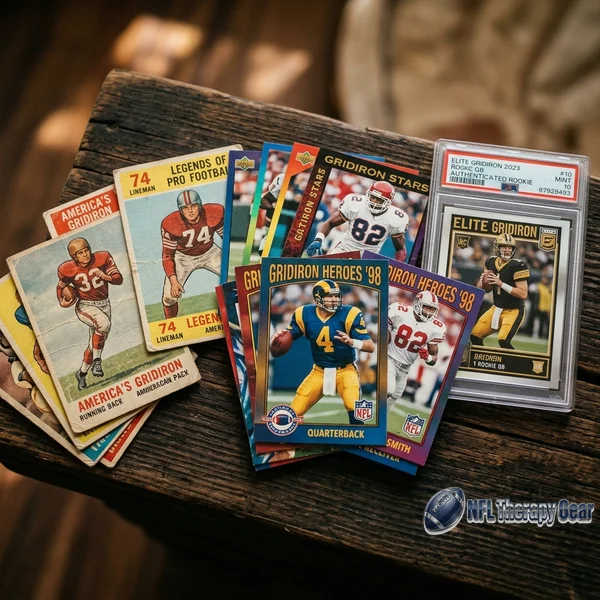
The grading process involves submitting cards to a grading company, where trained evaluators examine each card under magnification, assess its condition characteristics, and assign a numerical grade. Graded cards are then sealed in tamper-evident plastic holders — commonly called “slabs” — that display the assigned grade alongside the card’s identification information.
Understanding grading terminology helps collectors communicate about condition with precision. A card graded “Mint” (9) shows only the most minor imperfections visible under close examination. “Near Mint-Mint” (8) allows slightly more visible wear. “Gem Mint” (10) represents essentially perfect condition — the highest achievable grade, reserved for cards with no visible flaws even under magnification.
The relationship between grade and collector interest is not always linear. For vintage cards from the 1950s and 1960s, a grade of 6 or 7 may represent an exceptionally well-preserved example, since cards from that era typically show significant wear from decades of handling. For modern cards produced with more durable materials and often protected from the moment of opening, higher grades are more common and the premium associated with a perfect 10 may be proportionally greater.
Storage, Preservation, and Display
Proper storage remains fundamental to card preservation regardless of a card’s age, rarity, or grading status. The primary enemies of cardboard collectibles are moisture, temperature fluctuation, UV light exposure, and physical contact.
Penny sleeves — thin, transparent plastic sleeves — provide a first layer of protection against surface scratching and fingerprint oils. Top loaders — rigid plastic holders — add structural protection against bending and corner damage. For long-term storage, cards in penny sleeves placed inside top loaders and stored upright in cardboard storage boxes represent the standard archival approach.
Binder pages — transparent sheets with individual card pockets — offer an alternative storage method that allows browsing without handling individual cards. However, older binder pages made from PVC (polyvinyl chloride) can release plasticizers over time that damage card surfaces. Modern collectors use binder pages made from polypropylene or polyethylene, which are chemically inert and safe for long-term contact with cardboard.
Display options for football cards range from simple desk stands for individual cards to wall-mounted magnetic cases and custom-built display frames for complete sets. UV-filtering cases protect displayed cards from light-induced fading, which is particularly important for cards printed with inks that are susceptible to photodegradation.
Climate control matters more than many collectors realize. Cardboard absorbs and releases moisture in response to ambient humidity, and repeated cycles of absorption and release cause warping, delamination, and surface deterioration. Maintaining storage environments between forty and fifty-five percent relative humidity minimizes these risks. Extreme temperatures — both hot and cold — can also damage adhesives used in memorabilia cards and affect the flexibility of plastic holders.
Rookie Cards and Their Significance
Within the broader landscape of football card collecting, rookie cards hold a particular distinction. A rookie card is generally defined as a player’s first appearance on a card from a major, nationally distributed set. For many collectors, the rookie card represents the foundational piece in any player-specific collection — the earliest commercially produced image of an athlete at the professional level.
The definition of what constitutes a “true” rookie card has evolved over the decades. In the Topps-monopoly era, the answer was simple: a player’s first Topps card was the rookie card. With the introduction of multiple manufacturers in the late 1980s, the question grew more complicated. A player might appear in Score, Topps, Pro Set, and Fleer sets issued within weeks of each other during their first season. Each of these first-year appearances technically qualifies as a rookie card, though the market typically assigns different levels of interest to different manufacturers and sets.
Modern manufacturers address this complexity through official rookie card designation programs. Cards bearing specific rookie logos or designations are identified by the manufacturer as official rookie cards, providing a clearer framework than the informal definitions of earlier decades. These designated rookie cards appear only during a player’s first NFL season, and their official status is recognized by major grading services in their identification labels.
Set Building and Thematic Collecting
Beyond individual card acquisition, many collectors pursue complete sets — assembling every card in a particular annual issue or thematic subset. Set building provides a structured goal that adds purpose to the collecting experience. Completing a set requires tracking which cards you have, identifying which you need, and systematically filling gaps through trades, purchases, or pack openings.
Thematic collecting offers another organizational approach. Rather than pursuing complete sets, thematic collectors focus on specific categories — all cards from a particular team, all rookie cards from a particular draft class, all cards featuring a specific stadium, or all cards from a particular manufacturer’s product line. This approach allows collectors to build coherent, personally meaningful collections without the open-ended commitment of completing every set issued across multiple decades.
The Modern Landscape
Today’s football card market bears little resemblance to the bubble gum packs of fifty years ago. Products range from mass-market offerings designed for casual collectors and children to ultra-premium releases with individual packs priced in the hundreds or thousands of dollars. The market supports multiple manufacturers, each producing dozens of distinct products across the calendar year.
Digital technology has influenced the hobby in ways both obvious and subtle. Online marketplaces have expanded the secondary market from local card shops and regional shows to a global network where a collector in Tokyo can purchase a card from a seller in Pittsburgh within minutes. Authentication has improved through searchable serial number databases and manufacturer verification programs. Social media has created communities where collectors share their finds, discuss trends, and build connections that would have been geographically impossible in earlier decades.
The fundamental appeal of football cards, however, has remained remarkably stable across eras. They are small, portable, visually engaging objects that connect fans to the players and teams they follow. Whether printed on thin cardboard with gum stains from a 1952 pack or encased in a graded slab with a serial number linking to an online authentication database, a football card serves the same basic purpose it always has: it puts a piece of the game into a fan’s hands.
References:
- Pro Football Hall of Fame — Trading Card History and Collections
- Beckett Media — Card Collecting Resources and Historical Database
- PSA (Professional Sports Authenticator) — Card Grading Standards and Population Reports
- Library of Congress — American Popular Culture and Ephemera Collections
- Smithsonian National Museum of American History — Sports Memorabilia Archives