When November arrives and the temperature drops below the threshold where baseball-style caps provide sufficient warmth, the beanie becomes the headwear of necessity. A knitted cap that covers the ears, hugs the skull, and traps body heat that would otherwise escape from the head’s uninsulated surface is not just a fashion accessory in cold-weather football markets — it is a practical survival tool that makes the difference between enjoying a game and enduring one.
NFL beanies combine this practical cold-weather function with team identity display, putting franchise colors and logos on the headwear format best suited for the season when games matter most. The variety within this category — from simple cuffed knit caps to elaborate pom-pom styles with multi-color jacquard patterns — provides options for every combination of warmth requirement, style preference, and team representation.
Beanie Styles and Silhouettes
Cuffed Beanies
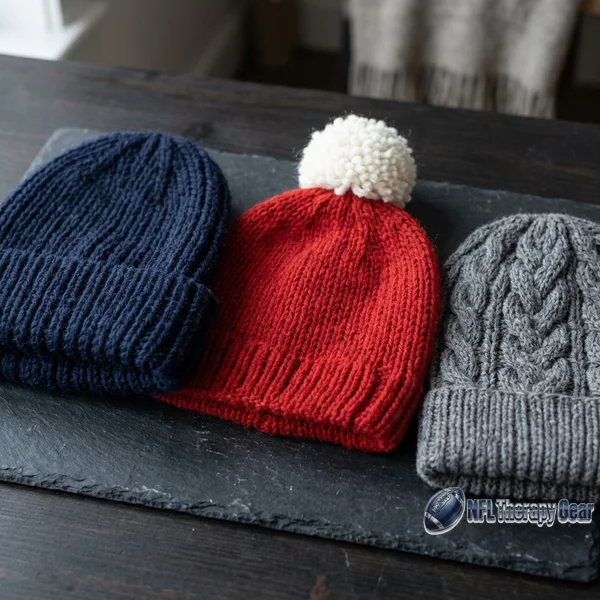
The cuffed beanie — where the bottom edge is folded upward to create a doubled band around the forehead and ears — is the most traditional and widely recognized beanie format. The cuff serves multiple purposes: it creates a thicker, warmer band around the most cold-sensitive area of the head, it provides a finished edge that conceals raw-cut or rib-start transitions, and it offers a prominent surface for team logos and text that face forward in a naturally readable orientation.
Cuff depth affects both the beanie’s appearance and its coverage area. Shallow cuffs (approximately one to two inches) create a cleaner, more understated look while preserving maximum crown height. Deep cuffs (three inches or more) produce a substantial band that emphasizes the cuff as a design feature and provides additional ear coverage when pulled down. Some wearers adjust cuff depth based on conditions — rolling a deeper cuff in mild cold and extending it for maximum coverage when temperatures plummet.
The internal architecture of the cuff affects how it holds its folded position. Well-constructed cuffed beanies use ribbed knitting at the cuff section that provides enough elasticity to maintain the fold without rolling or flipping open. Loosely knitted cuffs tend to unfurl during wearing, requiring frequent repositioning that becomes tedious during extended outdoor exposure.
Uncuffed and Slouch Beanies
Uncuffed beanies sit directly on the head without a folded band, creating a streamlined profile that some wearers prefer for its simplicity and contemporary aesthetic. Without the cuff’s added thickness, uncuffed beanies produce a thinner, closer-fitting look that works well with high-collar jackets and layered neckwear where cuff bulk might create uncomfortable stacking.
Slouch beanies extend beyond the skull’s natural shape, creating excess fabric that drapes or bunches at the back of the head. This intentional oversizing produces a relaxed, casual aesthetic that differs markedly from the close-fitting, skull-conforming look of standard beanies. The slouch style accommodates larger hairstyles more comfortably than close-fitting alternatives and provides a more fashion-forward appearance that appeals to fans who view their headwear as a style statement rather than purely a warmth solution.
Pom-Pom Beanies
The pom-pom — a spherical yarn tuft attached to the beanie’s crown — adds playful personality to winter headwear. NFL pom-pom beanies have experienced sustained popularity as the format’s cheerful, spirited character aligns well with game-day energy and communal fan enthusiasm. Pom-poms in team colors add a vertical accent that increases the beanie’s visual height and creates movement — the pom-pom bounces and sways with head movement, adding dynamic visual interest that static beanie styles lack.
Pom-pom attachment methods affect durability and maintenance. Some pom-poms are permanently sewn to the crown, while others use snap or button attachments that allow removal for washing, storage, and optional wearing without the pom-pom. Removable pom-poms provide versatility — the same beanie can present a playful character for game days and a more restrained appearance for everyday wear — but the attachment mechanism must be secure enough to prevent loss during vigorous game-day celebrations.
Earflap and Trapper Beanies
Earflap beanies extend coverage panels that fold down over the ears, providing direct warmth to the ear area that standard beanies protect only through their general coverage. The flaps may be built into the beanie’s construction (integral flaps) or attached as separate panels that can be tied up or folded when full ear coverage is not needed. Trapper-style beanies add faux-fur or fleece lining to the earflaps, creating a cold-weather headwear option that handles extreme conditions where standard beanies provide insufficient protection.
Materials and Construction
Acrylic Knit
Acrylic yarn is the most common material for NFL beanies, offering a combination of softness, color vibrancy, affordability, and easy care that other fibers cannot match across all four qualities simultaneously. Acrylic takes dye exceptionally well, producing vivid team colors that resist fading through repeated washing. The fiber is inherently hypoallergenic and does not trigger the itching and skin irritation that some wearers experience with wool.
The thermal performance of acrylic is adequate for moderate cold but falls short of natural wool’s insulating capability in extreme conditions. For temperatures above the mid-twenties Fahrenheit, quality acrylic beanies provide sufficient warmth for most fans. Below that range, acrylic beanies benefit from layering a hood over the beanie or upgrading to wool or fleece-lined alternatives that provide superior insulation for the coldest game-day conditions.
Wool and Wool Blends
Wool beanies provide superior insulation compared to acrylic through wool fiber’s natural ability to trap air within its crimped structure and maintain warmth even when damp. Merino wool — a fine-fiber variant that is softer and less scratchy than traditional coarser wools — has expanded wool’s appeal in the beanie market by addressing the comfort concerns that previously kept wool-sensitive wearers in acrylic alternatives.
Wool-acrylic blends combine wool’s thermal performance with acrylic’s color vibrancy and easy-care properties, creating a compromise that satisfies fans who want better warmth than pure acrylic without the care requirements and cost of one-hundred-percent wool. Common blend ratios range from sixty-forty to fifty-fifty wool-acrylic, with higher wool content providing proportionally better insulation at the cost of increased price and care complexity.
Fleece and Fleece-Lined Beanies
Fleece beanies — constructed entirely from polyester fleece fabric rather than knitted yarn — provide a different aesthetic and tactile experience than traditional knit beanies. The smooth, uniform surface of fleece creates a cleaner look than the textured surface of knit construction, and the fabric’s consistent thickness provides even warmth distribution without the thin spots that can develop in loosely knitted areas.
Fleece lining inside knitted beanies combines the traditional knit exterior appearance with the soft, wind-blocking warmth of a fleece interior. This dual-layer construction significantly increases the beanie’s thermal performance by eliminating the wind penetration that occurs through the open stitches of knit construction. The fleece layer also adds comfort against the skin, providing a smooth contact surface that avoids the texture variations and potential itchiness of direct yarn-to-skin contact.
Knit Patterns and Team Identity
The knitting pattern on an NFL beanie serves as both structural and decorative element. Simple ribbed knitting (alternating knit and purl columns) provides stretch and recovery for secure fit while creating a clean, understated texture. Cable-knit patterns add dimensional surface interest through twisted stitch sequences that create rope-like raised textures. Fair Isle and jacquard patterns use multiple yarn colors to create geometric designs that can incorporate team logos, wordmarks, and decorative motifs into the knitted fabric itself.
Striping — horizontal bands of alternating team colors — is the most common team-identity pattern in NFL beanies. Stripe width, color sequence, and the number of color changes within the design create distinct visual identities that differ between teams even when using similar basic color palettes. A beanie with wide alternating stripes reads differently from one with narrow multi-stripe sequences, and these pattern variations allow manufacturers to produce multiple beanie designs for the same team that feel distinct despite sharing the same color palette.
Wordmark knitting integrates team names or abbreviations directly into the knitted pattern using contrasting yarn colors. This technique makes the team name part of the fabric itself rather than an applied decoration, creating a more integrated, premium appearance than screen-printed or embroidered text applied to a plain-knit surface.
Cold Weather Performance
The head accounts for a significant percentage of body heat loss in cold conditions, making effective head covering one of the most impactful steps for maintaining comfort during winter stadium attendance. A properly insulating beanie can reduce overall heat loss enough to noticeably improve whole-body comfort, even when the body’s core and extremities are identically dressed.
Ear coverage is particularly important because ears are thin, exposed, and have limited blood flow — characteristics that make them among the first body parts to feel cold and the most susceptible to cold-weather discomfort and injury. Beanies that extend below the ear line provide the basic coverage needed, but the fit must be snug enough to keep the fabric in position against the ear rather than riding up above the ear opening when the wearer moves or turns their head.
Wind resistance varies significantly between beanie constructions. Open-stitch knit patterns allow wind to penetrate the fabric, reducing effective warmth in windy conditions. Tight-gauge knitting, wind-blocking membrane layers, and fleece linings all reduce wind penetration. Stadium locations on upper levels experience significantly higher wind exposure than sheltered lower sections, making wind-resistant beanie construction particularly valuable for fans seated in elevated areas exposed to cross-stadium airflow.
Layering a hood over a beanie creates a two-layer head insulation system that handles the coldest conditions fans are likely to encounter at outdoor games. The beanie provides the close-fitting insulation layer, while the hood adds a wind-blocking outer shell that protects the beanie’s insulating layer from wind that would otherwise reduce its effectiveness. This combination can maintain comfortable head warmth in temperatures that would overwhelm either layer used independently.
Coordinating Cold Weather Accessories
NFL beanies function most effectively as part of a coordinated cold-weather accessory system that includes scarves, gloves, and neck gaiters in matching or complementary team colors. A matched set — beanie, scarf, and gloves in the same team design and color — creates a cohesive appearance that projects intentional outfit coordination rather than random assembly. Many manufacturers produce these items as coordinated sets, ensuring exact color matching and design consistency across all pieces.
Neck gaiters — tubular fabric pieces that pull over the head and settle around the neck — complement beanies by covering the gap between the beanie’s lower edge and the jacket’s collar that would otherwise expose the neck and lower face to cold air. Team-branded neck gaiters in fleece or performance fabric provide wind protection for the lower face during the coldest stadium conditions while maintaining visible team identity through logo placement on the gaiter’s front panel.
Glove and beanie coordination extends beyond color matching. Material consistency matters — a wool beanie pairs more naturally with leather or knit gloves than with synthetic athletic gloves, while a performance-fabric beanie coordinates better with technical fleece or synthetic gloves. This material harmony creates a unified aesthetic that communicates coherent outfit planning rather than mismatched accessory selection.
Stadium-Specific Wearing Strategies
Different stadium seating locations create different cold-weather headwear needs. Fans in enclosed or partially covered seating areas face less wind exposure and may find lightweight acrylic beanies sufficient. Fans in upper-deck open-air seating — where wind speeds can be dramatically higher than at ground level — need wind-resistant fleece-lined or heavy-gauge knit beanies that can maintain warmth against sustained wind exposure.
Evening and late-afternoon games present colder conditions than midday starts, requiring warmer beanie selections for games that extend into sunset and post-sunset temperatures. Fans attending prime-time games or late-season afternoon games should plan their headwear for the coldest temperatures they will encounter, which occur during the fourth quarter and post-game exit — not during the warmer pre-game and first-half conditions.
Tailgate activities before games involve more movement and social interaction than seated game watching, which affects headwear needs. Active tailgating generates body heat that may make heavy beanies uncomfortably warm, while the social setting may favor style-forward options over purely functional thermal choices. Carrying a backup beanie — a lighter option for active pre-game activities and a heavier option for seated game viewing — addresses both needs without compromise.
Beanie Gifting Guide
NFL beanies rank among the most successful team-branded gifts because they solve the sizing challenge that makes apparel gifting risky. The stretchy knit construction accommodates a wide range of head sizes without the precise sizing requirements of fitted caps or the body-proportion concerns of clothing items. A gift-giver who knows only the recipient’s team affiliation can select a beanie with reasonable confidence that it will fit comfortably and appropriately.
Gift presentation can elevate beanie gifts from casual stocking-stuffer to premium present. Pairing a beanie with matching accessories — a coordinated scarf, gloves, or a team-branded hand warmer — creates a complete cold-weather fan package that demonstrates thoughtful selection beyond a single-item grab. Presentation in a branded box or gift bag adds tactile and visual value that enhances the gift-opening experience.
Seasonal timing makes beanies ideal for holiday gifting, when cold weather is either present or approaching and football season is in its most compelling late-season and playoff stretch. A new team beanie received in December is immediately useful, immediately wearable, and immediately connected to the current season’s most exciting games — a relevance advantage that off-season gifts cannot match.
Care and Storage
Beanie care is relatively straightforward compared to structured headwear. Most acrylic beanies tolerate machine washing in cold water on gentle cycle, followed by air drying flat. The absence of structural stiffeners eliminates the distortion concerns that make machine washing risky for structured caps. Lay-flat drying prevents the stretching that occurs when wet beanies are hung to dry, which can permanently elongate the knitted fabric and distort the intended fit.
Wool and wool-blend beanies require gentler handling — hand washing in cool water with wool-specific detergent, followed by reshaping on a towel and flat drying. The additional care effort preserves wool’s insulating properties and prevents the felting (compaction and stiffening) that occurs when wool is machine agitated or exposed to hot water.
Pom-pom maintenance involves periodic fluffing to restore fullness after compression during storage or wearing. Gently separating and fluffing the yarn strands with fingers, or briefly steaming the pom-pom over a kettle, restores the round, full shape that defines a well-maintained pom-pom beanie. Detached or unraveling pom-pom strands can be trimmed with scissors to maintain a clean, even surface without affecting the overall pom-pom shape or density.
Off-season storage should protect beanies from moth damage (particularly wool-content beanies), dust accumulation, and compression. Storing beanies flat or loosely folded in a sealed container with cedar blocks or lavender sachets provides moth deterrence and maintains the knitted fabric’s loft and shape through the months between football seasons.
References:
- NFL.com — Official Fan Cold Weather Apparel
- Cotton Incorporated — Natural Fiber Thermal Research
- AATCC — Textile Thermal Performance Standards
- Textile World — Knitting Technology and Yarn Materials
- The Woolmark Company — Wool Performance and Care Research