Introducing children to team fandom through apparel creates some of the earliest and most durable associations between family identity and team loyalty. A child wearing the same team colors as their parents learns that fandom is a shared family experience — a lesson communicated through the simple, powerful language of matching clothing. The team jersey a child wears to their first live game often becomes a treasured memento that outlasts the child’s ability to fit into it, stored as a physical marker of a formative experience.
Children’s NFL apparel carries additional considerations beyond those that govern adult team clothing. Safety requirements, durability demands, growth accommodation, and fabric suitability for children’s sensitive skin and active lifestyles all influence what constitutes an appropriate selection for young fans. Understanding these child-specific factors helps parents and gift-givers select team apparel that serves children well across the unique demands of childhood wearing.
Sizing Systems for Children’s NFL Apparel
Infant Sizing (0-24 Months)
Infant NFL apparel follows month-based sizing — zero to three months, three to six months, six to nine months, twelve months, eighteen months, and twenty-four months. These size designations correspond to average body measurements at each age range, but individual infant growth patterns vary widely enough that age-based sizing is approximate rather than precise.
Experienced parents and gift-givers often size up by one increment from the child’s actual age, particularly for gift purchases where the garment may not be worn immediately. An infant receiving a twelve-month-size team onesie as a gift at six months will grow into it rather than being unable to wear it. This sizing-up approach is especially prudent for gifts given near the beginning of an age range, when the child has the most growth remaining before reaching the size’s intended measurements.
Toddler Sizing (2T-5T)
Toddler sizing uses the T-suffix system (2T, 3T, 4T, 5T) that roughly corresponds to age in years but incorporates adjustments for the broader proportions typical of toddler bodies — larger diaper-accommodating seat and thigh measurements relative to waist size, and proportionally longer torso length relative to limb length. Toddler sizes transition into youth sizes at approximately age four to five, though the exact transition point depends on the individual child’s growth trajectory.
The challenge of toddler sizing for team apparel is the rapid growth rate during these years. A toddler may move through two or three sizes within a single NFL season, making it difficult to invest in apparel that will remain wearable from September through February. Parents who want continuous team-branded options for their toddler throughout the season should consider purchasing pieces at the beginning and middle of the season rather than investing in a single garment expected to last the entire season.
Youth Sizing (XS-XL / 4-20)
Youth sizing spans the widest age range — roughly ages four through fourteen — and uses either letter sizing (extra-small through extra-large) or numerical sizing (four through twenty) depending on the manufacturer. This extended range encompasses dramatic developmental changes, from young children with compact, proportionally uniform bodies to adolescents approaching adult proportions with lengthening limbs and developing gender-specific body differences.
The translation between letter and numerical youth sizes varies between manufacturers, creating confusion for parents accustomed to one system who encounter products sized in the other. Size charts remain the most reliable guide for navigating this inconsistency — measuring the child’s chest, waist, hip, and height and comparing these measurements to the specific product’s size chart produces better fit results than attempting to convert between sizing systems based on general equivalency assumptions.
Material Requirements for Children’s Apparel
Softness and Skin Sensitivity
Children’s skin is more sensitive than adult skin to irritation from rough fabric textures, scratchy seams, and chemical residues from manufacturing processes. NFL apparel designed specifically for children addresses these sensitivity concerns through fabric selection (softer cotton variants, brushed interiors), construction details (flat-locked seams that minimize skin contact with raw stitch edges), and manufacturing processes (pre-washed fabrics that remove chemical residues before the garment reaches the child).
Tagless labeling — where care instructions and brand information are printed directly onto the interior fabric rather than attached as a sewn-in tag — eliminates the neck irritation that traditional fabric tags cause against children’s sensitive neck skin. This seemingly minor detail makes a significant comfort difference for children who are unable to articulate specific discomfort sources and simply reject uncomfortable garments without explanation.
Durability for Active Wear
Children subject their clothing to stresses that adult wearing patterns rarely impose. Crawling, climbing, sliding, rough-housing, and playground activity create abrasion, stretching, and impact forces that exceed typical adult wearing demands. Children’s NFL apparel must withstand these demands while maintaining appearance quality — a team t-shirt that develops holes at the knees after two playground sessions fails the durability standard that children’s apparel must meet regardless of how well it displays the team logo.
Reinforced construction features — double-stitched seams, reinforced knee areas, chain-stitched hems that resist unraveling if snagged — extend the useful life of children’s team apparel through the aggressive wearing conditions that children impose. These construction upgrades add modest cost to the garment but dramatically extend its serviceability, making reinforced children’s apparel more economical on a per-wear basis than lighter-duty alternatives that require premature replacement.
Safety Standards
Children’s apparel is subject to safety regulations that do not apply to adult clothing. Flammability standards require children’s sleepwear to be either made from inherently flame-resistant fabric or constructed in snug-fitting designs that minimize fabric exposure to ignition sources. Lead-content limits restrict the use of certain dyes and decorative elements that could pose health risks through prolonged skin contact or mouthing behaviors common in young children.
Drawstring regulations restrict the use of drawstrings on children’s outerwear hoods and necks due to entanglement and strangulation risks. Children’s NFL hoodies and jackets designed for younger age groups use alternative closure methods — elastic, snap buttons, or hook-and-loop closures — that provide adjustable fit without the safety risks that drawstrings present. Parents purchasing team apparel from sources not subject to domestic safety regulations should verify that the products meet current safety standards for children’s clothing.
Category-Specific Considerations
Jerseys and Game-Day Wear
Children’s NFL jerseys bring young fans into the game-day uniform tradition, creating visual connection between the child’s wardrobe and the players they watch on television and in stadiums. Youth jerseys are available in both screen-printed (more affordable, lighter weight) and stitched (more durable, higher quality) versions, with the screen-printed option generally more practical for younger children whose rapid growth limits the garment’s wearable lifespan.
Player selection for children’s jerseys adds an element of mentorship to the apparel choice. Parents who select jerseys representing players known for sportsmanship, community involvement, and positive conduct reinforce values through the team apparel choice — the player whose name the child wears becomes a figure of identification and, potentially, behavioral modeling.
Cold Weather Apparel
Children require warmer outerwear than adults for equivalent temperature conditions because their smaller body mass produces less metabolic heat and their higher surface-area-to-volume ratio promotes faster heat loss. NFL winter apparel for children should prioritize thermal performance even more aggressively than equivalent adult pieces, with heavier insulation, snugger cuff and collar closures, and more comprehensive coverage than an adult might need for the same conditions.
Layering systems for children follow the same base-mid-outer framework used for adults but with simplified execution that children can manage independently. A team-branded thermal base layer, a team fleece mid-layer, and a weather-appropriate outer shell create a three-layer system that a child old enough to dress independently can assemble and adjust without adult assistance — promoting self-sufficiency while maintaining warmth and team identity display.
Everyday and School Wear
Team t-shirts, hoodies, and casual pants serve as everyday apparel for children who wear their team identity to school, after-school activities, and weekend outings. The frequency of wearing in these daily contexts — potentially three to four times per week — demands fabrics and construction that maintain appearance through heavy laundering rotation. A team hoodie worn to school every other day accumulates significantly more wash cycles per month than an adult garment worn once weekly, making durability a practical rather than optional characteristic for children’s everyday team apparel.
Growth Accommodation Strategies
Strategic sizing approaches extend the wearable lifespan of children’s NFL apparel despite the rapid growth that characterizes childhood. Purchasing slightly larger sizes with the expectation that the child will grow into them over the season provides extended utility, though excessively oversized garments create safety concerns (tripping on too-long pants, loose fabric catching on playground equipment) and comfort issues that undermine the garment’s purpose.
Adjustable features — elastic waistbands, roll-up sleeve cuffs, adjustable-length overall straps — accommodate growth within a single garment, extending its wearable period beyond what fixed-dimension construction allows. These adjustable elements serve as built-in growth accommodation that can add weeks or months of wearable life to each piece.
Sibling hand-me-down planning influences purchasing decisions for families with multiple children. Selecting durable, well-constructed team apparel in gender-neutral designs maximizes the likelihood that pieces can pass from older to younger siblings, multiplying the per-garment value across multiple children’s use. Neutral team apparel — pieces without gender-specific styling elements — passes between siblings of different genders without requiring modification, making neutrally designed team apparel the most economical choice for multi-child families.
Gift Selection for Young Fans
Selecting NFL apparel as gifts for children requires navigating the intersection of team preference, sizing uncertainty, and age appropriateness. Confirming the child’s current favorite team (which may differ from their parents’ team, particularly as children develop independent preferences) prevents the disappointment of receiving apparel for the wrong franchise — a surprisingly common gift-giving error that well-meaning relatives make by assuming family-wide team consistency.
Sizing for gifts benefits from the age-plus-one strategy: selecting the size one increment above the child’s current age provides growth room that extends the gift’s wearable period. A five-year-old receiving a size six or seven team hoodie as a December holiday gift will likely wear it through the following football season rather than outgrowing it by spring.
Age-appropriate design considerations affect gift reception. Younger children respond enthusiastically to bright colors, mascot imagery, and playful graphic treatments, while older children and pre-teens increasingly prefer understated, adult-adjacent designs that avoid the juvenile treatments they associate with their younger years. Understanding this aesthetic transition helps gift-givers select designs that recipients will actually want to wear rather than politely accepting and consigning to the closet.
School Dress Code Compliance
Many children’s primary wearing context for team apparel is school, making dress code compatibility an important practical consideration. Schools with uniform policies may prohibit team apparel entirely, while schools with casual dress codes may allow team clothing within guidelines that restrict graphic content, color range, or garment types. Understanding the specific school’s policies before purchasing team apparel for school-age children prevents the frustration of acquiring garments that cannot be worn during the hours when children are most dressed.
Spirit days, casual Fridays, and special event days at schools that normally restrict casual clothing create designated opportunities for team apparel wearing. Children who attend schools with dress restrictions often view these special days as treasured opportunities to display team identity, making the team apparel they own for these occasions particularly valued regardless of its limited wearing frequency.
Building a Seasonal Wardrobe
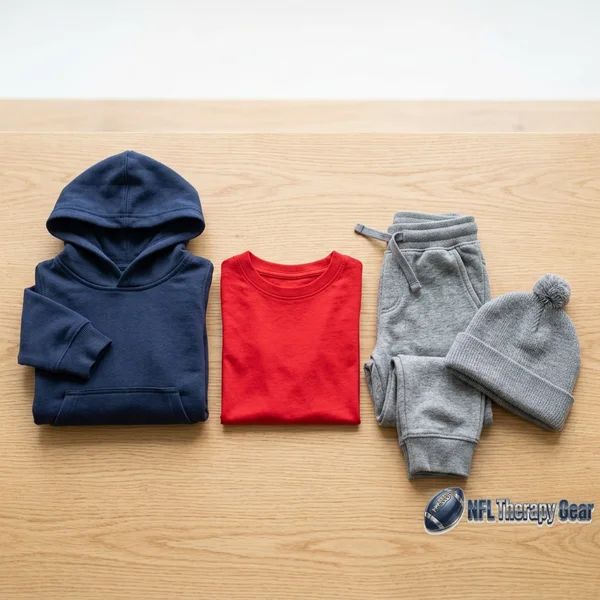
A practical children’s NFL wardrobe covers the major seasonal needs with appropriate team-branded options. For the football season specifically, a basic rotation might include: two team t-shirts for warm early-season games, one team hoodie or sweatshirt for mid-season cool weather, one team jacket or heavy outerwear for cold late-season conditions, and a team beanie and gloves set for the coldest games. This five-to-six-piece rotation provides appropriate coverage from September through January without excessive investment in garments the child may outgrow by the following season.
Off-season team apparel — lightweight tees, casual shorts, and sleepwear — extends team identity display throughout the calendar year. Training camp attendance, draft day celebrations, and casual summer wear all provide opportunities for year-round team apparel use that keeps the team connection active during the months between football seasons.
Family Bonding Through Team Apparel
Matching family team apparel creates visual unity that strengthens the sense of shared identity central to family fandom. Parents and children wearing coordinated team outfits to games, watch parties, and community events project a collective family identity that reinforces the child’s sense of belonging to something larger than themselves. This belonging — communicated through the simple act of wearing the same colors — contributes to the social and emotional value that team affiliation provides for children developing their sense of identity and community.
Game-day dressing rituals — choosing outfits together, applying face paint, discussing which players to represent — add ceremonial significance to team apparel that transforms clothing from mere garments into participation tools. Children who associate team apparel with these engaging, family-centered rituals develop positive associations with both the team and the family traditions built around supporting it, creating memories that persist long after the child outgrows the physical garments.
First-game jerseys, milestone season shirts, and commemorative apparel from significant games serve as physical markers of a child’s developing fan journey. Parents who preserve these items after the child outgrows them create a tangible timeline of fandom development that can be reviewed and appreciated as the child grows — a jersey collection that documents not just team history but personal and family history intertwined with it.
Care for Children’s Team Apparel
Children’s apparel care must balance the increased laundering frequency that children’s wearing patterns demand against the preservation of graphic quality and fabric integrity that maintains the garment’s appearance. Pre-treating stains promptly — grass, food, marker, paint, and other childhood-specific staining agents — prevents permanent discoloration that cannot be removed once set.
Cold water washing on gentle cycle with mild, child-appropriate detergent provides effective cleaning while minimizing fabric degradation per wash cycle. The cumulative impact of frequent washing is significant — a children’s team t-shirt washed twice weekly experiences over one hundred wash cycles per year, making each cycle’s material impact consequential when multiplied across the garment’s total laundering history.
Air drying is particularly valuable for children’s apparel because it eliminates the heat exposure that accelerates graphic deterioration and fabric breakdown. The time investment in air drying produces measurably longer garment life, which matters more for children’s apparel than adult apparel because children’s aggressive wearing patterns already compress the garment’s useful lifespan.
Stain-resistant treatments applied to new garments create a protective barrier that makes common childhood stains easier to remove during laundering. These treatments — available as spray-on products applied to the fabric surface — reduce the staining impact of food spills, grass contact, and art-supply accidents that are routine hazards in children’s daily activities.
References:
- NFL.com — Official Kids Fan Apparel Collection
- U.S. Consumer Product Safety Commission — Children’s Clothing Safety Standards
- Cotton Incorporated — Children’s Textile Research
- AATCC — Textile Performance and Safety Testing
- Textile World — Children’s Apparel Manufacturing