The football helmet sits at the intersection of engineering, artistry, and tribal identity. For millions of fans across the United States, helmet designs carry the weight of childhood memories, family traditions, and regional pride. A single stripe pattern or color combination can trigger decades of emotional attachment. Yet most fans have only a passing familiarity with how these designs came to exist — the accidents, arguments, and strokes of genius that shaped the headgear now recognized as some of the most iconic visual symbols in American sports.
What follows is a walk through the design history of NFL helmets, from the bare heads of football’s earliest years to the elaborate paint schemes and sculpted shells that define the modern game. This is not a story about protection or performance metrics. It is a story about how a piece of equipment became a canvas for identity.
The Bare-Head Era and Leather Origins
Professional football in its earliest form featured no head protection at all. Players in the 1890s and early 1900s took the field with their hair slicked down or, at most, grew it long as a makeshift cushion. The concept of a football helmet did not gain traction until the 1910s, and even then, adoption was spotty and inconsistent.
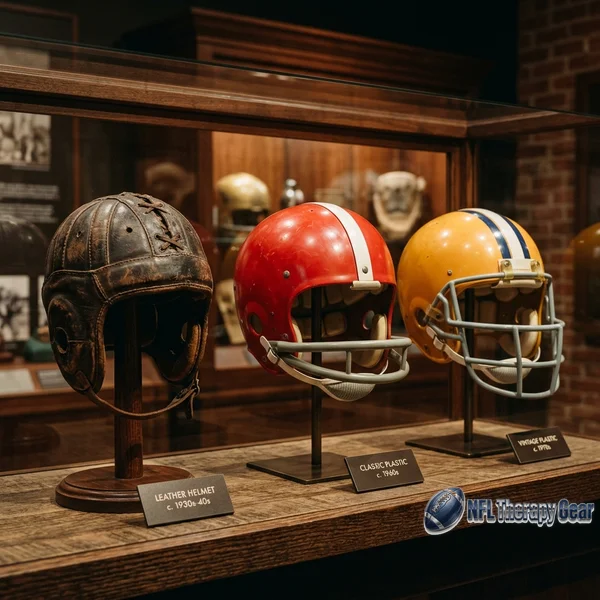
The first helmets were soft leather caps that resembled aviator headgear. They fit snugly against the skull, covered the ears with flap-like extensions, and offered minimal impact absorption. Their primary purpose was preventing cuts and abrasions rather than absorbing blows. Manufacturers crafted these early pieces from strips of leather stitched together in a patchwork pattern, sometimes padded with thin layers of felt or cotton wadding.
By the 1920s, when the American Professional Football Association reorganized as the National Football League, leather helmets had become more common but remained optional. Many players considered them uncomfortable, hot, and even a liability — opponents could grab the ear flaps during tackles. The helmets had no logos, no paint, and no distinguishing marks. A player’s helmet looked essentially identical whether he played for the Decatur Staleys or the Canton Bulldogs.
The 1930s brought gradual refinements. Manufacturers began hardening the leather through treatment processes, creating a stiffer shell that held its shape better on impact. Some models introduced rudimentary suspension systems — webbing or fabric cradles inside the shell that created a gap between the leather exterior and the player’s head. These internal systems represented the first serious attempt at distributing force across a broader area rather than concentrating it at the point of contact.
The Transition to Plastic
World War II changed everything about helmet construction, though not in the way most people assume. Wartime rationing restricted leather supplies, pushing manufacturers to experiment with alternative materials. John T. Riddell, whose company had been producing sporting goods since the 1920s, introduced a molded plastic football helmet in 1939, but widespread adoption did not occur until after the war ended and plastic manufacturing technology matured.
The plastic helmet revolution happened gradually during the late 1940s and early 1950s. These new shells were lighter than hardened leather, easier to manufacture in consistent shapes, and — critically for our story — provided a smooth, paintable surface. For the first time, teams could apply color to their helmets without the paint cracking, peeling, or being absorbed unevenly by leather grain.
The NFL did not mandate helmets until 1943, and the last player to regularly play without one, Dick Plasman of the Chicago Bears, retired after the 1941 season. By the mid-1950s, the plastic helmet was standard equipment across the league, and teams began to recognize its potential as a branding tool.
Early plastic helmets came in a limited palette. Manufacturers offered basic colors — white, black, brown, and a few primaries — applied through spray painting. The paint jobs were often crude by modern standards, with visible brush strokes, uneven coverage, and colors that faded quickly under sun exposure and physical contact. Teams repainted helmets frequently, sometimes multiple times per season.
The Birth of Helmet Logos
The concept of placing a team logo on a helmet emerged slowly and without a grand master plan. The Los Angeles Rams are widely credited as the first NFL team to add a logo to their helmets, introducing ram horns painted onto the shells in 1948. The story behind this innovation involves Fred Gehrke, a halfback who also happened to be a trained artist. Gehrke hand-painted curved horns onto the leather helmets of his teammates during the offseason, working from his home in a project that combined athletic identity with genuine artistic skill.
Gehrke’s ram horns were not immediately copied league-wide. Other teams took years to follow suit, and some resisted the concept entirely. The Cleveland Browns, founded in 1946, deliberately chose not to place a logo on their helmets — a decision that has persisted for decades and remains one of the most distinctive visual identities in professional football precisely because of its absence of decoration.
Through the 1950s and 1960s, teams gradually adopted helmet logos. The process was remarkably informal by modern standards. Owners, coaches, and occasionally players themselves made decisions about logo designs, colors, and placement. There was no centralized branding authority, no focus groups, and no market research. A team owner might sketch something on a napkin, hand it to a local sign painter, and have a new helmet design by the following Sunday.
Several of the designs created during this period have endured with minimal modification for over half a century. The Dallas Cowboys introduced their distinctive star logo in 1964. The Pittsburgh Steelers adopted the Steelmark logo — originally the symbol of the American Iron and Steel Institute — on one side of their helmets in 1962. The Green Bay Packers added their oval “G” in 1961. These designs were products of their era: bold, simple, and optimized for visibility from stadium seats long before the age of high-definition television.
The Single-Bar to Full-Cage Face Mask Evolution
The face mask deserves mention in any discussion of helmet aesthetics because it fundamentally altered the visual profile of the helmet. Early plastic helmets featured completely open faces. The first face masks appeared in the early 1950s — simple single-bar attachments that crossed in front of the nose and mouth.
Throughout the 1960s and 1970s, face mask designs grew more complex. Double bars, triple bars, and eventually full-cage configurations emerged, driven by position-specific needs. Linemen gravitated toward heavier cage designs with more bars, while quarterbacks and receivers preferred minimal configurations that maximized their field of vision.
From a design perspective, face mask configurations became part of a helmet’s identity. The single-bar look of a quarterback’s helmet carries different connotations than the full-cage setup of a defensive lineman. Collectors and historians often identify specific eras partly by face mask style — a vintage helmet with a single clear bar immediately signals a particular decade.
Face mask color also became a design element. Teams chose chrome, grey, white, black, or color-matched bars to complement their overall helmet scheme. Some teams changed face mask colors over the years, creating subtle but noticeable shifts in their visual identity that dedicated fans could identify at a glance.
The Painting Arms Race of the 1960s and 1970s
As television transformed professional football from a regional curiosity into a national obsession during the 1960s, helmet design took on new commercial significance. Teams needed to be instantly recognizable on small, grainy television screens. This requirement drove a trend toward bolder colors, higher contrast, and more distinctive design elements.
The merger of the NFL and the American Football League in 1970 brought additional teams and additional design philosophies into the mix. AFL teams had generally embraced more adventurous visual identities than their NFL counterparts. The Kansas City Chiefs, Miami Dolphins, and Cincinnati Bengals brought distinctive color palettes and logo concepts that expanded the visual vocabulary of professional football.
Paint technology improved significantly during this period. Automotive-grade paints replaced the hardware-store products that teams had used in earlier decades. Metallic finishes, glossy clear coats, and more durable color formulations allowed for richer, more sophisticated appearances that held up better over the course of a season.
Stripe patterns became another key differentiator. The center stripe running from front to back — sometimes called a dorsal stripe — appeared on many helmets during this era. Teams experimented with width, color combinations, and the number of stripes. Some designs featured a single thick stripe, others used multiple thin stripes separated by contrasting colors. The stripe became such a fundamental part of helmet identity that removing or modifying it could generate significant fan reaction.
Decals Versus Paint
A quiet revolution in helmet decoration occurred when teams began using adhesive decals instead of direct painting for their logos. Decals offered several practical advantages: they could be mass-produced with consistent quality, applied quickly, and replaced individually if damaged. They also allowed for more intricate designs than hand-painting could reliably achieve.
The Pittsburgh Steelers’ use of the Steelmark logo provides one of the more interesting decal stories. The team originally placed the decal on only the right side of the helmet as a test. The asymmetric look proved so popular that it became permanent — the Steelers remain one of the only NFL teams with a logo on just one side of their helmet.
Not all teams embraced decals equally. Some continued using painted-on designs well into the modern era, viewing them as more authentic or durable. The quality gap between painted and decal-applied logos narrowed over the decades as decal technology improved, but the distinction mattered to purists and collectors who could often identify the application method by examining surface texture and edge quality.
For collectors of vintage helmets, the paint-versus-decal distinction carries particular significance. Hand-painted logos from the 1950s and 1960s show brush marks, slight color variations, and other characteristics of individual craftsmanship. These imperfections are, paradoxically, markers of authenticity that distinguish genuine vintage pieces from later reproductions.
The Modern Shell and Throwback Culture
Helmet shell design continued evolving through the 1980s, 1990s, and into the twenty-first century. Polycarbonate replaced earlier plastics, creating shells that were simultaneously lighter and more resistant to impact. Shell shapes changed as well — modern helmets have a distinctly different profile than their predecessors, with extended jaw protection, more rounded contours, and integrated ventilation systems.
These structural changes created an interesting aesthetic challenge. Helmets from the 1960s have a different silhouette than helmets from the 2000s, which means that putting a vintage paint scheme on a modern shell does not perfectly replicate the original look. The proportions are different, the curves are different, and the face mask attachment points have shifted.
The NFL’s throwback uniform program, which allowed teams to wear historical uniform designs for select games, created a fascinating intersection of nostalgia and modern manufacturing. Teams like the Tampa Bay Buccaneers, who wore their original creamsicle orange designs, and the New England Patriots, who revived their red-jersey Pat Patriot look, generated enormous fan enthusiasm for vintage aesthetics.
Throwback helmets became some of the most sought-after collector items in the memorabilia market. Fans who had grown up watching teams in their classic uniforms suddenly had access to modern reproductions of those designs. Several authorized manufacturers produce full-size and mini replica helmets featuring both current and historical paint schemes, giving collectors the ability to build displays spanning multiple decades of a franchise’s visual history.
Regional Identity and Emotional Attachment
What makes vintage helmets resonate so deeply with fans is their connection to place and time. A helmet design is not just a color scheme — it represents a city’s identity during a particular era. The Houston Oilers’ columbia blue helmets with the oil derrick logo evoke 1970s Texas. The Baltimore Colts’ horseshoe design carries the memory of a franchise that departed its original city in the middle of the night in 1984.
Teams that have relocated or folded leave behind orphaned helmet designs that take on additional emotional weight. The original Cleveland Browns helmet design persisted even after the franchise moved to Baltimore and became the Ravens. When Cleveland was awarded an expansion franchise, the new team adopted the same helmet design as its predecessor — acknowledging that the visual identity belonged to the city as much as it belonged to the organization.
This emotional dimension explains why helmet design changes generate such passionate fan responses. When a team alters its helmet — even subtly — it touches something deeper than graphic design preferences. It connects to personal memories, family traditions, and regional pride. The outcry that greets unpopular redesigns and the celebration that accompanies popular ones reflect the genuinely meaningful relationship between fans and these painted shells.
Collecting and Displaying Vintage Helmets
For those interested in vintage NFL helmets as collectible items, understanding the nuances of different eras enhances appreciation considerably. Helmets from the leather era are exceptionally rare and require specialized knowledge to evaluate. Plastic helmets from the 1950s through 1970s are more available but vary enormously in condition, originality, and provenance.
Display considerations for vintage helmets differ from those for modern pieces. Older plastics are more susceptible to UV damage, which can cause yellowing, cracking, and paint degradation over time. Collectors who display vintage helmets typically use enclosed cases with UV-filtering glass or acrylic, maintain consistent temperature and humidity levels, and avoid positioning pieces in direct sunlight.
The distinction between game-used helmets, team-issued helmets, and retail replicas matters considerably in the collecting world. Game-used helmets bear the marks of actual play — paint chips, scuff marks, sweat stains, and sometimes grass stains that confirm their presence on a football field. Team-issued helmets may have been prepared for a player but never worn in a game. Retail replicas are produced for consumer purchase and, while often faithful reproductions, were never part of a team’s actual equipment inventory.
Authentication of vintage helmets involves examining construction details that changed over time: interior padding systems, chin strap attachment hardware, face mask mounting configurations, and shell manufacturer markings. Several established authentication services examine these physical characteristics to verify the era and, in some cases, the specific team association of vintage helmets. Collectors are generally advised to work with reputable authentication organizations when evaluating pieces that claim specific historical significance.
The Artistic Dimension
It is worth stepping back and acknowledging that NFL helmet design, at its core, is a form of applied art. The designers and sign painters who created these iconic looks were solving a visual problem: how to create an instantly recognizable identity that works from a distance, at speed, in variable lighting conditions, on a curved three-dimensional surface.
The best helmet designs succeed because they obey fundamental principles of graphic design — contrast, simplicity, proportion, and color harmony — while also carrying emotional meaning specific to their community. The winged helmet of the Detroit Lions, adapted from the University of Michigan’s design, communicates something about the relationship between college and professional football in that region. The Philadelphia Eagles’ wing design, which has evolved through multiple iterations, reflects decades of organizational evolution.
Graphic designers, branding professionals, and sports historians have all studied NFL helmet designs as case studies in effective visual identity. The longevity of many designs — some essentially unchanged for fifty or sixty years — speaks to their fundamental effectiveness. In an era when corporate logos are redesigned every few years chasing contemporary trends, the staying power of classic helmet designs is remarkable.
Preserving the Heritage
Museums, private collections, and team archives play an important role in preserving the physical artifacts of helmet design history. The Pro Football Hall of Fame in Canton, Ohio, maintains an extensive collection of helmets spanning the sport’s history, from fragile leather specimens to the elaborately painted shells of the modern era.
Team facilities often display historical helmet collections in their lobbies and hallways, giving visiting fans and media a tangible connection to franchise history. These displays typically arrange helmets chronologically, allowing viewers to trace design evolution season by season.
The care requirements for preserving vintage helmets underscore their status as genuinely fragile historical artifacts. Leather helmets from the 1920s and 1930s require careful humidity control to prevent cracking and deterioration. Early plastic helmets from the 1950s can become brittle over time, with shells developing hairline cracks that worsen if exposed to temperature fluctuations. Even the paint itself ages differently depending on the formulations used in different decades.
For fans who appreciate NFL helmet design history, the available resources have expanded considerably in recent years. Published books documenting helmet designs across eras, online archives cataloguing design changes by team and season, and museum exhibitions focused on sports visual identity all provide pathways for deeper exploration.
The story of NFL helmet design is ultimately a story about how functional equipment became cultural artifact. What started as a utilitarian protective device evolved into one of the most powerful visual symbols in American sports — a canvas that carries the collective memory of millions of fans across generations. The painted shells sitting in display cases and mounted on collectors’ walls are not merely souvenirs. They are chapters in a still-unfolding story about identity, community, and the remarkable human impulse to decorate even the most practical objects with meaning.
References:
- Pro Football Hall of Fame — Historical Archives and Exhibit Collections
- NFL.com — League History and Uniform Database
- Smithsonian National Museum of American History — Sports Equipment Collections
- Uni Watch — Paul Lukas, Historical Uniform Research and Documentation
- Gridiron Uniform Database — Helmet Design Chronology by Team