Throwback helmets exist in the space between nostalgia and accuracy, between honoring history and accommodating modernity. When a team wears a historical helmet design on a modern Sunday, they are not actually wearing what their predecessors wore — they are wearing a contemporary interpretation of a historical design, built with modern materials and construction techniques but painted and decorated to evoke a specific moment in the franchise’s visual past.
This tension between authenticity and practicality makes throwback helmets a fascinating subject for fans who care about design heritage. Understanding what makes each era’s helmet designs distinctive — the specific shapes, colors, logo treatments, and structural features that define different periods — provides the vocabulary needed to appreciate throwback designs and evaluate how faithfully they represent their historical sources.
The Leather Era: 1920s Through 1940s
The earliest professional football helmets were soft leather caps that bear almost no visual resemblance to what modern fans think of as a football helmet. These leather helmets hugged the skull closely, covered the ears with hinged or sewn flap extensions, and featured visible stitching along the seams where leather panels were joined. They had no face protection, no chin straps in the modern sense (early models used thin leather straps), and no surface decoration of any kind.
The construction of leather helmets evolved through their decades of use. Early examples from the 1920s were essentially aviator-style caps adapted for football, made from relatively soft leather with minimal internal padding. By the 1930s, manufacturers had developed stiffer leather treatments and introduced internal suspension systems — fabric webbing that created an air gap between the shell and the player’s head, providing rudimentary shock absorption that the direct-contact designs of earlier helmets lacked.
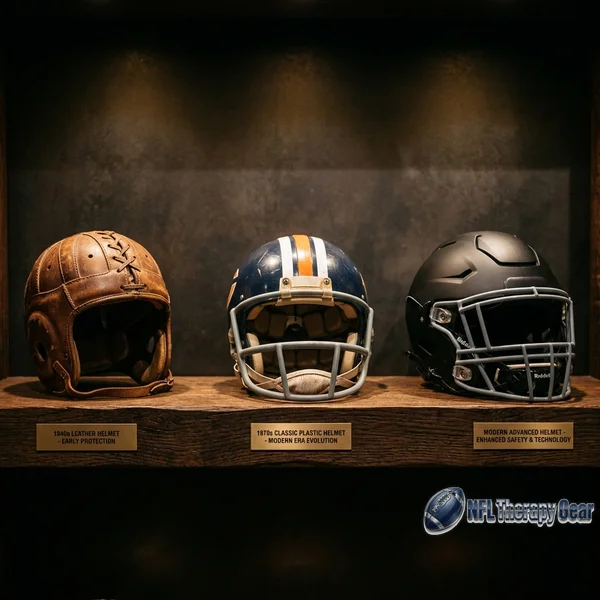
The leather helmet’s distinctive appearance comes from several visual characteristics: the warm brown color of tanned leather (ranging from honey to dark mahogany depending on the tanning process), the visible stitching patterns where panels join, the rounded profile that follows the skull’s natural contours closely, and the ear flaps that give the helmet its most recognizable silhouette element. These visual signatures make leather helmets immediately identifiable as products of football’s earliest decades.
Throwback reproductions of leather-era helmets face a fundamental challenge: modern safety requirements prohibit using actual leather helmets in professional competition. When teams reference the leather era in throwback presentations, they typically do so through uniform elements other than the helmet, or through commemorative ceremonies where replica leather helmets are displayed but not worn during live play.
Replica leather helmets produced for collectors and display purposes can achieve remarkable fidelity to original construction methods. Skilled artisans produce hand-stitched leather helmets using historically appropriate materials and techniques, creating pieces that capture the visual and tactile character of originals. The quality range among replicas is wide, from mass-produced novelty items that approximate the general appearance to premium handcrafted reproductions that faithfully replicate specific models from specific decades.
The Early Plastic Era: 1950s Through 1960s
The transition from leather to plastic in the late 1940s and early 1950s produced helmets with distinctive characteristics that set them apart from both their leather predecessors and their modern descendants. Early plastic helmets were made from suspension-type construction — a hard outer shell with an internal web of fabric straps that supported the player’s head away from the shell surface.
The shell shapes of early plastic helmets differ noticeably from modern designs. They sit higher on the head, have a rounder profile when viewed from the front, and lack the extended jaw protection and facial coverage that characterize contemporary helmets. The face mask openings are larger and less structured, reflecting an era when face protection ranged from no mask at all to simple single-bar configurations.
Paint schemes on early plastic helmets tended toward simplicity. Many teams used solid colors with minimal decoration — a single stripe down the center, a painted initial, or no decoration at all beyond the base color. The introduction of team logos onto helmets occurred gradually during this period, and the logo designs that appeared were often simpler and more crudely applied than their modern counterparts, reflecting the hand-painting and early decal technology available at the time.
Throwback helmets referencing the 1950s and 1960s must adapt these visual characteristics to modern shell shapes and safety construction. The result is always a compromise — the colors and logos may be historically accurate, but the helmet’s silhouette, face mask configuration, and overall proportions necessarily differ from the originals. Knowledgeable fans can spot these differences, which creates an interesting dynamic where throwback designs are simultaneously authentic (in their surface decoration) and anachronistic (in their structural form).
The Classic Era: 1970s Through 1980s
Helmets from the 1970s and 1980s represent what many fans consider the “classic” era of NFL helmet design. The shell shapes had evolved into forms closer to modern profiles, face mask designs had developed the multi-bar configurations still recognizable today, and team logo treatments had matured into the bold, distinctive designs that define franchise identity for millions of fans.
The Riddell VSR series helmets that dominated this period have a distinctive profile — slightly taller and more angular than modern helmets, with a characteristic squared-off back panel and visible snap points where face masks attach. This profile is so associated with the era that throwback designs from the 1970s and 1980s are sometimes produced on VSR-style shells specifically to capture the period-correct silhouette.
Stripe patterns reached their peak visual prominence during this era. Many teams featured bold center stripes — single or multiple lines running from the front edge of the helmet to the back — that contributed significantly to the helmet’s visual identity. The width, number, and color combinations of these stripes varied between teams and sometimes changed between seasons, creating a rich catalog of variations that throwback designs can reference.
Face mask configurations from this period were typically simpler than modern designs, with fewer bars and more open visibility. The gray face mask — a standard option that many teams used throughout the 1970s — is a frequently noted detail in throwback accuracy. Teams that later switched to colored, white, or chrome face masks sometimes return to gray when producing throwback designs to maintain period authenticity.
Paint and decal quality improved significantly during the classic era. Automotive-grade paints replaced earlier formulations, producing richer, more durable colors. Decals reached a quality level where they could reproduce complex logo designs with consistent accuracy, and the adhesive technology improved to the point where decals maintained their appearance through a full season of use without significant degradation.
The Modern Era: 1990s Through Present
Helmets from the 1990s onward feature shell designs that prioritize protection and performance alongside visual identity. Modern shells are lower-profile, extend further down toward the jaw, and incorporate ventilation systems that were absent in earlier designs. Face mask configurations have grown more complex, with position-specific designs that range from minimal two-bar setups for quarterbacks to full-cage configurations for linemen.
The materials used in modern helmet shells have evolved from the basic plastics of earlier decades to advanced polycarbonate and composite materials that offer superior impact management. These materials enable shell shapes and wall thicknesses that were impossible with earlier plastics, producing helmets that look different from their predecessors even when decorated identically.
Modern paint and finish technology has expanded the visual options available to teams. Metallic finishes, matte surfaces, chrome effects, and gradient color treatments are all achievable with current production methods. Some teams have embraced these new capabilities, producing helmet finishes that would have been technically impossible in earlier decades, while others maintain traditional gloss finishes that maintain visual continuity with their historical designs.
When modern teams produce throwback designs, they must decide which historical details to reproduce faithfully and which to modify for contemporary requirements. Logo placement, color matching, and stripe patterns can typically be reproduced with high accuracy. But shell shape, face mask style, and finish quality are constrained by current equipment, creating visible differences between throwback designs and their historical inspirations that attentive fans readily identify.
Design Accuracy in Throwback Programs
The NFL’s throwback uniform program has evolved in its approach to historical accuracy. Early throwback efforts sometimes took significant liberties with historical designs, using approximate color matches and simplified logo treatments. More recent programs have demonstrated greater commitment to precision, with teams commissioning historical research to identify exact paint formulas, logo proportions, and stripe specifications from their target eras.
Color matching presents one of the most persistent challenges in throwback design. Paint formulations change over time, and the specific shade of a team’s color in 1968 may not match the shade used in 1978 or the shade in use today. Determining the “correct” color for a throwback design requires research into historical paint specifications, photographic evidence (complicated by the color reproduction limitations of photography from different eras), and surviving original equipment that can serve as physical color references.
Logo accuracy involves not just reproducing the general design but matching specific proportions, line weights, and color relationships that may have changed subtly over the decades. Teams that have used variations of the same basic logo for fifty or more years may have accumulated dozens of slightly different versions — each one “official” in its specific season — that must be distinguished and correctly matched to the target era.
The Alternate Helmet Rule and Its Impact
NFL rules governing helmet usage have directly shaped the throwback helmet landscape. For years, the league’s “one-shell rule” required players to use the same helmet shell throughout the season, preventing teams from switching to different-colored shells for throwback games. This rule, implemented for safety reasons — to ensure that each player’s helmet was properly fitted and broken in — significantly limited throwback design options for teams whose historical helmets featured different base colors than their current equipment.
The modification of this policy to allow alternate helmets under specific conditions represented a significant shift that expanded throwback possibilities dramatically. Teams that had been unable to produce accurate throwback presentations because their historical helmet colors differed from their current shells gained the ability to use period-correct colors for special games. The policy change triggered a wave of throwback programs across the league as teams took advantage of the expanded design flexibility.
Safety protocols for alternate helmets ensure that the expanded design options do not compromise player protection. Alternate shells must meet the same certification standards as primary helmets, must be properly fitted to each player, and must undergo the same conditioning process that ensures optimal performance during competition. These requirements mean that teams planning to use alternate helmets must begin preparation well before the scheduled throwback game, allowing time for fitting, adjustment, and the break-in period that each helmet requires.
The commercial dimension of the alternate helmet rule has been substantial. Each new throwback helmet design creates demand for corresponding replica products — full-size replicas, mini helmets, and related merchandise — that extends the throwback’s presence beyond the single game in which it appears. This commercial potential has incentivized teams to develop throwback programs that reference their most visually distinctive historical periods, creating consumer interest that translates into merchandise revenue.
Helmet Customization and Sticker Traditions
Some NFL franchises have traditions of adding performance-based decals or stickers to helmets during the season — small symbols applied after significant performances or milestones. These sticker traditions add individual character to helmets over the course of a season, creating visual evidence of personal and team achievement that accumulates game by game.
The most recognized helmet sticker tradition involves small decals placed on the helmet after each game, with additional markers for particular achievements. A helmet photographed late in a season shows its accumulated stickers like campaign ribbons on a military uniform — a visual record of the season’s journey and the individual player’s contributions to it. Throwback programs must decide whether to incorporate or omit these sticker traditions based on whether the referenced era included them.
Other teams maintain clean helmet surfaces throughout the season, treating the helmet as a consistent brand presentation that should not vary between games. This philosophical approach treats the helmet as an institutional symbol rather than a personal journal — the team’s identity presented uniformly regardless of individual performance or seasonal progress. Throwback designs for these teams face simpler reproduction requirements since the historical helmets they reference maintained similarly consistent appearances.
Collecting Throwback Helmets
Replica throwback helmets represent a popular collecting category that spans multiple product tiers. Full-size replica helmets, produced by authorized manufacturers, reproduce throwback designs on display-quality shells. These replicas range from standard production models to limited-edition pieces that incorporate premium materials, individually numbered production runs, and enhanced detail work.
Mini helmets — scaled-down replicas typically about one-quarter the size of full-size helmets — offer an accessible entry point for throwback design collecting. Their smaller size allows collectors to display multiple designs in limited space, facilitating comprehensive collections that cover a franchise’s entire visual history or a specific era’s league-wide design landscape.
Authentication and licensing markings distinguish officially licensed throwback replicas from unauthorized reproductions. Holograms, license tags, and manufacturer identification appear on legitimate products, providing collectors with verification that their purchases represent authorized reproductions produced to established quality standards. These markings also connect the replica to the specific licensing agreements that govern the use of team trademarks, ensuring that the designs reproduced on the replica have been approved by the teams and the league.
Display and care for throwback helmet replicas follows the same principles applicable to other helmet memorabilia — UV protection for painted surfaces, stable temperature and humidity for shell materials, and dust management for displayed pieces. The specific care requirements depend on the replica’s construction materials and finish type, with metallic finishes, matte surfaces, and glossy paints each requiring slightly different maintenance approaches to preserve their appearance over time.
Displaying throwback helmets alongside their modern counterparts creates compelling visual comparisons that highlight how dramatically helmet design has evolved. Side-by-side presentations reveal differences in shell shape, face mask complexity, ventilation design, and overall proportions that casual observation might miss. These comparative displays serve educational purposes, helping viewers understand the technological progression that has shaped helmet development from simple protective headgear to the engineered safety equipment worn today.
Building a comprehensive throwback helmet collection for a single franchise creates a three-dimensional timeline of that team’s visual identity. Progressing from earliest available designs through every subsequent era reveals the cumulative effect of incremental design changes — how small adjustments in color shade, logo placement, stripe width, and shell contour compound over decades to produce the dramatic differences visible between a team’s first helmets and their current equipment. This evolutionary perspective enriches appreciation for both the historical designs and the current iteration, placing each within a continuum of development that spans the franchise’s entire existence.
References:
- Pro Football Hall of Fame — Helmet Design Archives and Historical Equipment
- NFL.com — Uniform and Helmet Heritage Database
- Gridiron Uniform Database — Comprehensive Helmet Design Chronology
- Uni Watch — Uniform and Equipment Design Research
- Smithsonian National Museum of American History — Sports Equipment Collections