A great sports photograph freezes a fraction of a second and makes it permanent. The ball is suspended in air, forever uncaught. The tackler’s arms are extended, forever reaching. The crowd behind is blurred into a wash of color and emotion, forever cheering or gasping or holding its breath. In professional football, where action unfolds at extraordinary speed across a hundred-yard canvas, the challenge of capturing the decisive moment has pushed photographers and their technology to remarkable limits.
The history of NFL photography is simultaneously a history of photographic technology, a history of media access, and a history of visual storytelling. What photographs exist from different eras — and what they look like — depends as much on camera capabilities, film characteristics, and press policies as on the talent of the people behind the lenses. Understanding this context enriches appreciation of historic football photographs by revealing what each image required from the photographer and the technology of the moment.
The Early Decades: Limited Technology, Lasting Images
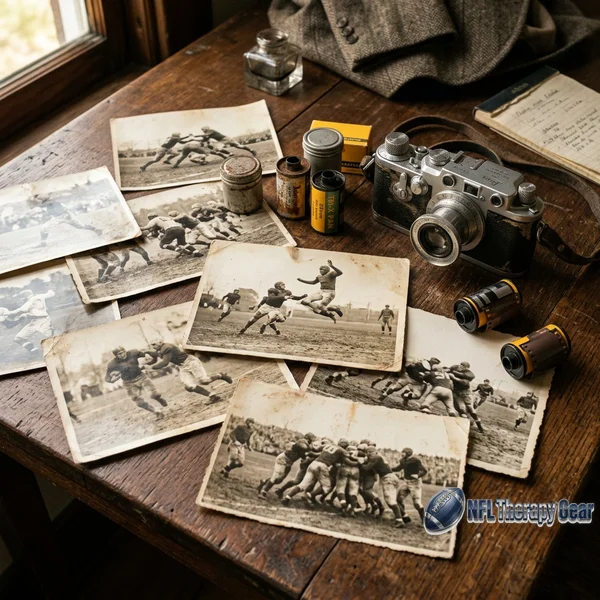
Photography at professional football games in the 1920s and 1930s was constrained by equipment that modern photographers would find unworkable. Large-format cameras requiring bulky tripods, slow film speeds that demanded bright light for adequate exposure, and manual focus systems that required anticipating action rather than reacting to it — these limitations shaped what early football photographs looked like and what moments they could capture.
Most photographs from this era are posed rather than captured in genuine action. Team portraits, individual player poses, and pre-game or post-game groupings dominate the photographic record because the cameras of the period could reliably produce sharp images of stationary subjects but struggled with the speed and unpredictability of live football. When action photographs do survive from the 1920s and 1930s, they typically show moments of relatively slow movement — a runner being wrapped up in a tackle, a kicker following through, or players lined up before a snap — rather than the explosive instants that define modern action photography.
Flash photography was impractical for outdoor sports during this period. Flash powder — the technology available before electronic flashbulbs — produced a single burst of intense light with a significant delay between trigger and ignition, making it useless for capturing unpredictable athletic moments. Photographers relied entirely on available sunlight, which meant that overcast days, late-afternoon shadows, and the reduced light of November and December games produced darker, grainier images than bright autumn afternoons.
Despite these technical constraints, early football photographs possess a raw quality that polished modern images cannot replicate. The players appear approachable and human, without the sculptured physiques and branded equipment that create visual distance in contemporary imagery. Muddy fields, simple uniforms, and sparse crowd backgrounds give these photographs an intimate, documentary character that connects viewers to professional football’s origins as a modest, gritty, regional enterprise.
The Mid-Century Revolution: Speed Graphic to Motor Drive
The technological landscape for sports photography changed dramatically between the 1940s and the 1960s. The Speed Graphic — a large-format press camera that had dominated professional photography — gradually gave way to 35mm single-lens reflex cameras that offered faster operation, more frames per roll, and the ability to change lenses quickly to adapt to different shooting situations.
The 35mm format transformed sports photography by making it possible to shoot rapidly and abundantly. Where a Speed Graphic photographer might expose a dozen plates during an entire game, a 35mm photographer could shoot several rolls of thirty-six exposures, capturing dozens of moments and selecting the strongest images afterward. This abundance changed the editorial process — photo editors gained access to more choices, enabling them to select images with greater precision and visual impact.
Telephoto lenses extended the photographer’s reach, allowing tight framing of action from positions along the sideline that would have been impossible with the shorter lenses typical of large-format cameras. The compression effect of telephoto optics — which brings foreground and background elements visually closer together — became a characteristic look in sports photography, producing images where players appear stacked in dramatic layers of overlapping action.
Motor-driven film advance, introduced in the late 1960s and becoming standard equipment through the 1970s, allowed photographers to capture sequences of images at several frames per second without manually advancing the film between exposures. This capability was particularly valuable in football, where decisive moments — the instant of a catch, the apex of a leap, the collision of a tackle — occur within fractions of a second that even the fastest manual film advance cannot reliably capture.
Color film’s transition from novelty to standard had profound effects on football photography. Early color film — Kodachrome, introduced in 1935 — produced saturated, warm-toned images that rendered the greens of football fields and the colors of team uniforms with a richness that black-and-white film could not approach. The cost and processing requirements of color film initially limited its use to magazine assignments, while newspaper photographers continued shooting black-and-white well into the 1980s. This economic divide means that the photographic record of NFL history exists in two parallel visual tracks — color images from magazines and books alongside black-and-white images from newspapers — each carrying different aesthetic qualities.
Iconic Photographic Moments
Certain football photographs have transcended their original publication contexts to become cultural icons — images recognized by people who cannot name the photographer, the game, or even the players involved. These images achieve iconic status through a combination of compositional excellence, emotional intensity, and historical significance that elevates them beyond sports documentation into visual art.
The qualities that make a football photograph iconic are worth examining because they reveal principles of visual storytelling that apply far beyond sports. Composition — the arrangement of elements within the frame — determines whether a photograph feels dynamic or static, chaotic or controlled, intimate or epic. The strongest football photographs use compositional techniques borrowed from fine art and cinematography: leading lines created by yard markers, rule-of-thirds placement of key subjects, and negative space that allows the eye to travel through the image.
Timing separates adequate photographs from extraordinary ones. The decisive moment in football often lasts less than a tenth of a second — the instant when a receiver’s fingers close around the ball, when a defensive player launches into a tackle, when a quarterback’s arm reaches full extension on a throw. Capturing this precise instant requires not just fast reflexes but anticipatory understanding of the game — knowing where the action will develop before it happens and positioning both camera and attention accordingly.
Emotional content gives photographs lasting resonance beyond their documentation of physical action. Images of celebration, disappointment, exhaustion, determination, and camaraderie connect viewers to the human experience underlying athletic competition. These emotional photographs often become more significant over time as the specific game outcomes they reference fade from memory while the universal emotions they capture remain immediately accessible.
The Sideline Access Evolution
Where photographers are allowed to stand has shaped what football photographs look like as much as any technological factor. Sideline access policies have evolved significantly over the decades, expanding and contracting in response to safety concerns, broadcast considerations, and the increasing commercialization of visual content.
In the early decades of professional football, photographers often mingled on the field among players and coaches, shooting from positions that placed them within feet of the action. This proximity produced intimate images but also created safety risks that led to gradual restrictions. Modern sideline access is carefully controlled, with designated shooting positions, credentialed access zones, and physical barriers that balance photographic access with participant safety and broadcast sightline requirements.
End zone positions became highly valued as the passing game grew in prominence through the 1970s and beyond. Photographers stationed behind the end zone could capture receivers making catches with the goal line as a compositional element, creating images that combined athletic action with the symbolic geography of scoring. Competition for premium end zone positions at major games reflects the value these positions offer for creating distinctive images.
Elevated shooting positions — from press boxes, catwalks, or specialized camera platforms mounted above the field — provide perspectives that sideline positions cannot achieve. Overhead views reveal the geometry of formations, the spacing of defensive coverages, and the patterns of offensive routes with a clarity that ground-level photography obscures. These elevated images serve both aesthetic and analytical purposes, combining visual drama with tactical insight.
Print Photography as Collectible
Original photographic prints from significant games and moments represent a collecting category that overlaps with both memorabilia and fine art. These prints — produced from original negatives or transparencies by the photographers or their authorized representatives — carry the photographer’s creative vision alongside the historical content of the image.
Vintage prints — those produced within a few years of the original exposure — are distinguished from later prints made from the same negatives. The materials used for vintage prints (paper type, chemical processing, toning) reflect the technology of their era, and the prints themselves carry the physical characteristics of their specific production moment. Print quality can vary between printings even from the same negative, as darkroom conditions, paper batches, and the printer’s interpretive choices all affect the final result.
Signed prints add an authentication dimension similar to signed memorabilia. Photographers who sign their prints establish a direct connection between the creative artist and the physical object, and authentication of photographer signatures follows the same general principles used for athlete autographs — comparison with known exemplars, consistency of materials, and provenance documentation.
Display and preservation of photographic prints follows the same principles applicable to other paper-based collectibles: UV-filtered glazing, acid-free mounting materials, controlled temperature and humidity, and protection from physical handling. Photographs are particularly sensitive to light exposure, and displayed prints should be positioned away from windows and bright light sources that can cause irreversible fading of photographic dyes and emulsions over time.
Wire Services and Photo Distribution
The wire service system — led by the Associated Press, United Press International, and other news agencies — played a crucial role in determining which football photographs reached national audiences. Wire service photographers covered games across the country, transmitting selected images to newspaper and magazine clients through electronic photo transmission systems that evolved from analog wirephoto technology to digital file transfer over the decades.
Wire service photographs carry particular historical significance because they represent the curated visual record of professional football as seen by the national media. Wire editors selected images based on news value, visual quality, and technical suitability for newspaper reproduction. The photographs that survived this editorial filter became the images that defined each game, each season, and each era in the public consciousness — not because they were necessarily the best photographs taken, but because they were the ones the wire services chose to distribute.
The physical archives of wire service photography contain millions of football images spanning decades of coverage. These archives, maintained by the wire services and in some cases transferred to museums and libraries, represent an irreplaceable visual record of professional football’s history. Researchers and publishers who access these archives encounter images that were never published — frames shot before and after the decisive moments, alternative angles of familiar events, and coverage of routine moments that lacked the news value to warrant distribution but carry historical interest in retrospect.
The credits printed alongside published photographs — “AP Photo,” “UPI Photo,” or specific photographer names — connect images to their creators and their organizational contexts. These credits, often overlooked by casual viewers, provide provenance information that helps collectors and researchers trace the origin and distribution history of specific images. Photography credits in vintage publications can identify previously anonymous images and connect them to specific games, dates, and photographers.
Preserving Photographic Archives
The preservation of historic football photographs extends beyond individual prints to encompass the negatives, transparencies, and contact sheets that constitute the raw material of photographic documentation. Film negatives are the primary source from which prints are produced, and their preservation ensures that future generations can produce new prints from original source material.
Black-and-white negatives, when properly stored, demonstrate remarkable longevity. Silver gelatin negatives from the 1940s and 1950s remain printable when kept in appropriate conditions — cool, dry environments with stable temperature and humidity. Color negatives and transparencies are more vulnerable to deterioration, with dye layers that can shift, fade, or develop color casts over decades of storage. Cold storage — refrigerated or frozen conditions — dramatically slows the chemical processes that cause color film deterioration.
Contact sheets — prints showing every frame on a roll of film at negative size — serve as visual indexes of shooting sessions. Photographers and photo editors used contact sheets to review and select images for enlargement and publication. Surviving contact sheets from historically significant games provide unprecedented insight into photographic decision-making, revealing which moments a photographer captured, how many frames were devoted to different aspects of the game, and which images were selected (usually marked with grease pencil) from the full array of available choices.
Digital archiving of analog photographic materials creates preservation copies that protect against physical loss while making collections more accessible to researchers. High-resolution scanning of negatives and prints produces digital files that can be studied, shared, and reproduced without subjecting original materials to the risks of physical handling. Major sports photography archives have undertaken systematic digitization programs, converting decades of film-based coverage into searchable digital databases that transform the accessibility of their holdings.
The Digital Transition
Digital photography’s arrival in the late 1990s and early 2000s fundamentally altered every aspect of sports photography — from capture through editing to distribution. Digital cameras eliminated film costs, provided immediate image review, and enabled the rapid transmission of images to editors and publishers within minutes of capture.
The volume of images produced at each game increased dramatically. Where a film photographer might shoot a thousand frames during a game, digital photographers routinely capture several thousand, relying on rapid editing workflows to identify and process the strongest images from each session. This abundance has raised the quality threshold — with more images to choose from, editors can be more selective, and only the most technically excellent and compositionally compelling images survive the editing process.
Despite these transformations, the fundamental skills of great sports photography remain unchanged. Anticipation, timing, compositional instinct, and emotional sensitivity still separate extraordinary images from competent documentation. The camera is a tool — more capable now than ever before — but the photographer’s eye, judgment, and understanding of the game continue to determine whether a photograph captures a moment or merely records one.
References:
- Pro Football Hall of Fame — Historical Photography Collection
- NFL.com — Photography Archive and Historical Images
- International Center of Photography — Sports Photography and Documentary Traditions
- Library of Congress — Prints and Photographs Division
- Smithsonian National Museum of American History — Photography and Sports Media Collections